








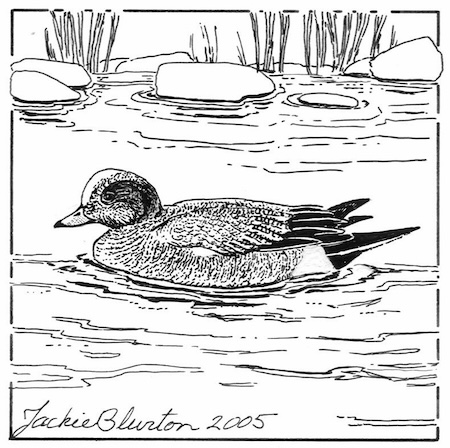
Art by Jackie Blurton
Nature Note by Dr. Roland Shook
The American Wigeon belongs to the surface feeding or puddle duck group. These are relatively light bodied ducks when compared to the diving ducks. When puddle ducks take off, they can spring into the air, and upon landing, they can come in at a very steep angle and plop down on the water. In contrast to this, diving ducks need to run on the surface of the water to gain enough air speed to generate enough lift to get into the air. When they land, again their air speed is much higher than puddle ducks, so they skid across the water before coming to a rest. Owing to their weight, puddle ducks sit higher in the water when compared to diving ducks. In the field, it is helpful to be able to separate ducks into these two major categories.
American Wigeons are the only duck characterized by a shiny white or buffy patch from the bill to the back of the head. Males have a prominent green area on the side of their head which can look black at a distance, and a white patch just forward of the black tail. The former name of "Baldpate" is derived from the white patch on the head.
Always look for rare or uncommon birds among the common species. Uncommon European Widgeons, with a red-brown head and creamy crown, are known to associate with flocks of the much more common American Wigeon.
In our area, this species is a common winter visitor to the ponds found on the golf course. Wigeons graze goose-like, on the grass surrounding the ponds in irregular flocks of over a hundred birds. Always ask permission before entering private property such as the golf course.
Art by Jackie Blurton
Nature Note by Dr. Roland Shook