



 Click to Search
Search
[{{{type}}}] {{{reason}}}
{{/data.error.root_cause}}
{{{_source.title}}} {{#_source.showPrice}} {{{_source.displayPrice}}} {{/_source.showPrice}}
{{#_source.showLink}} {{/_source.showLink}} {{#_source.showDate}}{{{_source.displayDate}}}
{{/_source.showDate}}{{{_source.description}}}
{{#_source.additionalInfo}}{{#_source.additionalFields}} {{#title}} {{{label}}}: {{{title}}} {{/title}} {{/_source.additionalFields}}
{{/_source.additionalInfo}}


From Our Place to Yours
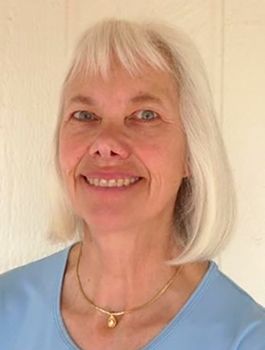
Jackie Blurton
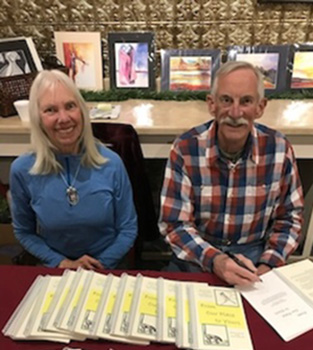
Jackie Blurton and Dr. Roland Shook sign copies of their book, From Our Place to Yours, at the a book signing at the Grant County Art Guild Gallery.

Roland Shook
- Art by Jackie Blurton. Jackie is the Activity Chair of Bird Alliance of Southwestern New Mexico, the Silver City Chapter of the National Audubon Society. www.birdallianceswnm.org .
- Text by Dr. Roland Shook. The late Dr. Shook was a professor of Biology at WNMU from 1992 to 2007. He was a past president of the NM Ornithological Society and Southwest New Mexico Audubon Society.
- From Our Place to Yours previously ran in the Silver City Daily Press from 1999 to 2006.
- Category: From Our Place to Yours
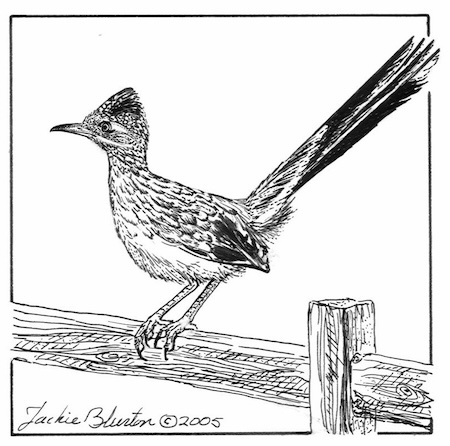 Art by jackie Blurton
Narrative by the late Dr. Roland Shook
When most people picture the Southwest in their minds’ eye there is no other bird that comes to mind more than the Greater Roadrunner.
This is our only large ground running bird with a crest and a very long tail. This species is brownish above and whitish below. The undersides are heavily streaked with brown. The overall manifestation of the bird gives it a shaggy appearance.
The Greater Roadrunner is a bird of open country from pinyon-juniper woodlands to the Sonoran Desert to the grasslands of southern Colorado and Oklahoma. It can often be seen perching on rocky outcroppings or fence posts.
- Category: From Our Place to Yours
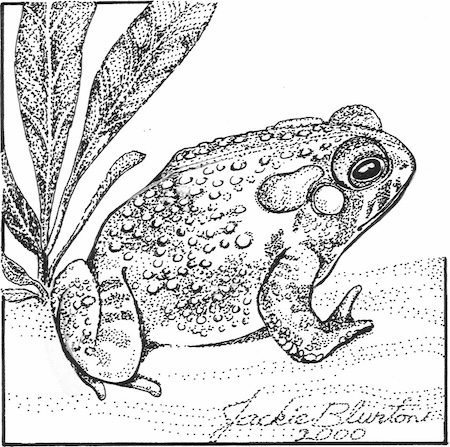 Woodhouse's Toad
Art by Jackie Blurton
Nature Note by the late Dr. Roland Shook
Toads, in general, have warty skins while frogs are smooth skinned amphibians. However, in some areas the term "frog" and "toad" can be used interchangeably. Although toads live mainly on land, they breed in the water and lay their eggs in strings.
This species has dry skin covered with numerous warts. The color of the back is usually olive or greenish, and there is usually a prominent light line down the middle.
- Category: From Our Place to Yours
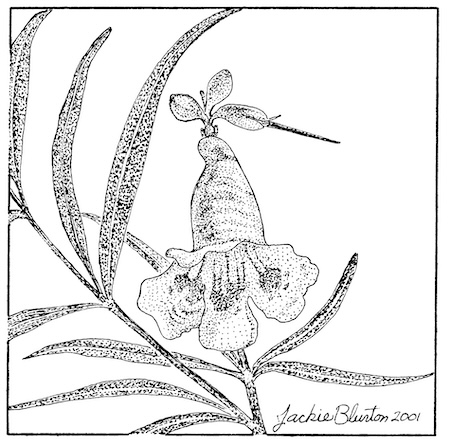
Desert Willow
Art by Jackie Blurton
Nature Note by the late Dr. Roland Shook
This species, found lining desert washes below 4,000 feet, is a shrubby tree from 6 to 15 feet in height when fully grown.
Although superficially resembling a willow, Desert-willows are closely related to the catalpa and are not a member of the willow family.
- Category: From Our Place to Yours
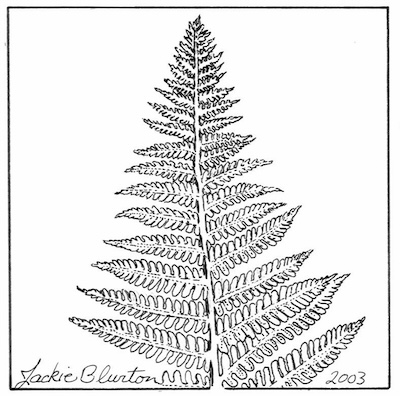
Bracken Fern
Art by Jackie Blurton
Nature Note by the late Dr. Roland Shook
Ferns are vascular plants (having tissues that conduct fluids) which have large feathery leaves. Typically, the leaves unroll from the tip during growth. In addition to leaves, ferns also have stems and roots. In some the stem is much reduced, while in others, like many tropical forms, the stem forms a tall column, hence the name "tree fern."
- Category: From Our Place to Yours
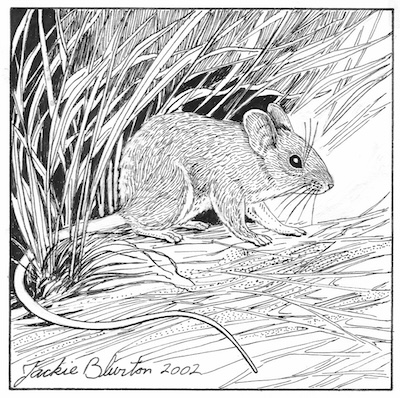
Western Harvest Mouse
Art by Jackie Blurton
Nature Note by the late Dr. Roland Shook
Harvest mice are characterized by conspicuous ears, grooved incisor teeth, and no external cheek pouches. Brownish in color; they suggest a small House Mouse. There are four species in the U.S.
Harvest mice prefer overgrown fields, grassy areas, marshes, and wood edges. They are nocturnal and good climbers; their diet consists primarily of plant cuttings, plant seeds, and insects.
The Western Harvest Mouse is a widespread species in western North America from the Pacific coast east to the Mississippi River, and Canada south to Mexico.
- Category: From Our Place to Yours
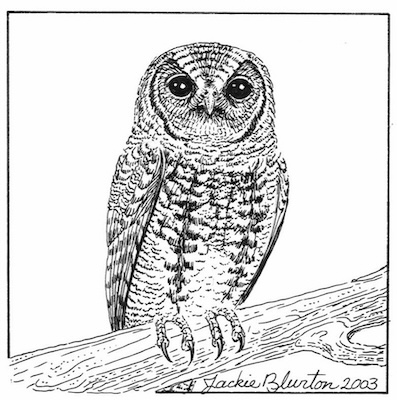 Art by Jackie Blurton
Nature Note by the late Dr. Roland Shook
Owls are divided into "typical" owls which include all our species except the Barn Owl. Barn Owls are characteristically different from the others. Hence biologists have put these two groups into separate families.
Flammulated Owls derive their name from the Latin for "a small, bright, flaming red thing". This description is an allusion to the rufous color in some color phases of this species.
Flammulated Owls are a bird of the West occupying a summer range from British Columbia south into Mexico. It winters from central Mexico to Guatemala. Flammulated Owls are smaller than Screech Owls and are largely gray with dark eyes, tawny shoulders, and inconspicuous ear tufts. The individuals in the southernmost part of their range are more reddish than the northern birds. Strictly nocturnal, this species nests and roosts in tree cavities.
- Category: From Our Place to Yours
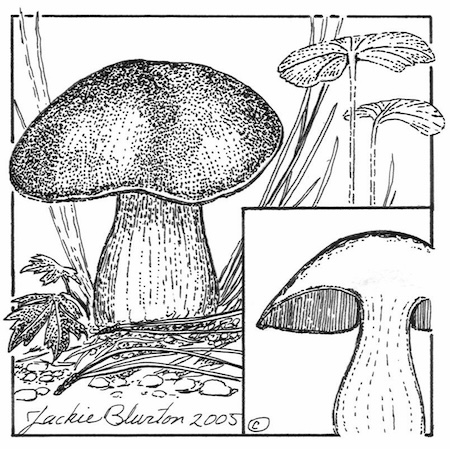
Art by Jackie Blurton
Nature Note by the late Dr. Roland Shook
Mushrooms are the visible fruiting bodies of fungi. The vegetative part grows mostly underground or hidden in some other substrate. Fungi lack chlorophyll and therefore they lack he ability to capture sunlight and turn it into organic matter. Because of this, fungi usually get their energy and nutrients from dead organic matter. However, there are several parasitic fungi.
Those who study fungi have found that the vegetative part of the plant often forms mutually beneficial relationship with the rootlets of trees and shrubs. The fungi can provide the tree with phosphorus, nitrogen and other nutrients while the plant provides the fungi with moisture and protection.
- Category: From Our Place to Yours
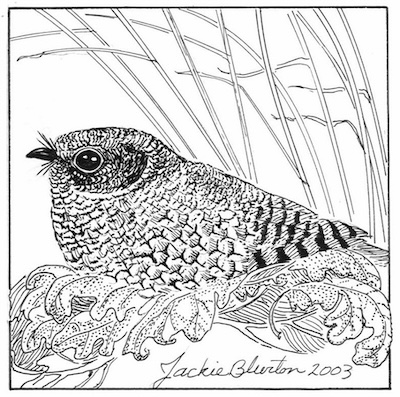
Common Poorwill
Art by Jackie Blurton
Nature Note by the late Dr. Roland Shook
This species, as well as some others, is included in a group called goatsuckers. Since the time of Aristotle, goatsuckers have had the mistaken reputation of attacking the udders of goats for food. The legend includes the fact that the udder withers when it has been sucked and that the goat goes blind. The family name for this group, Caprimulgidae, is derived from the Latin meaning "to milk goats", thus maintaining the legend.






Content on the Beat
WARNING: All articles and photos with a byline or photo credit are copyrighted to the author or photographer. You may not use any information found within the articles without asking permission AND giving attribution to the source. Photos can be requested and may incur a nominal fee for use personally or commercially.
Disclaimer: If you find errors in articles not written by the Beat team but sent to us from other content providers, please contact the writer, not the Beat. For example, obituaries are always provided by the funeral home or a family member. We can fix errors, but please give details on where the error is so we can find it. News releases from government and non-profit entities are posted generally without change, except for legal notices, which incur a small charge.
NOTE: If an article does not have a byline, it was written by someone not affiliated with the Beat and then sent to the Beat for posting.
Images: We have received complaints about large images blocking parts of other articles. If you encounter this problem, click on the title of the article you want to read and it will take you to that article's page, which shows only that article without any intruders.
New Columnists: The Beat continues to bring you new columnists. And check out the old faithfuls who continue to provide content.
Newsletter: If you opt in to the Join GCB Three Times Weekly Updates option above this to the right, you will be subscribed to email notifications with links to recently posted articles.
Editor's Notes
It has come to this editor's attention that people are sending information to the Grant County Beat Facebook page. Please be aware that the editor does not regularly monitor the page. If you have items you want to send to the editor, please send them to editor@grantcountybeat.com. Thanks!
Here for YOU: Consider the Beat your DAILY newspaper for up-to-date information about Grant County. It's at your fingertips! One Click to Local News. Thanks for your support for and your readership of Grant County's online news source—www.grantcountybeat.com
Feel free to notify editor@grantcountybeat.com if you notice any technical problems on the site. Your convenience is my desire for the Beat. The Beat totally appreciates its readers and subscribers!
Compliance: Because you are an esteemed member of The Grant County Beat readership, be assured that we at the Beat continue to do everything we can to be in full compliance with GDPR and pertinent US law, so that the information you have chosen to give to us cannot be compromised.
Submitting to the Beat
Those new to providing news releases to the Beat are asked to please check out submission guidelines at https://www.grantcountybeat.com/about/submissions. They are for your information to make life easier on the readers, as well as for the editor.
Advertising: Don't forget to tell advertisers that you saw their ads on the Beat.
Classifieds: We have changed Classifieds to a simpler option. Check periodically to see if any new ones have popped up. Send your information to editor@grantcountybeat.com and we will post it as soon as we can. Instructions and prices are on the page.