








Curve-billed Thrasher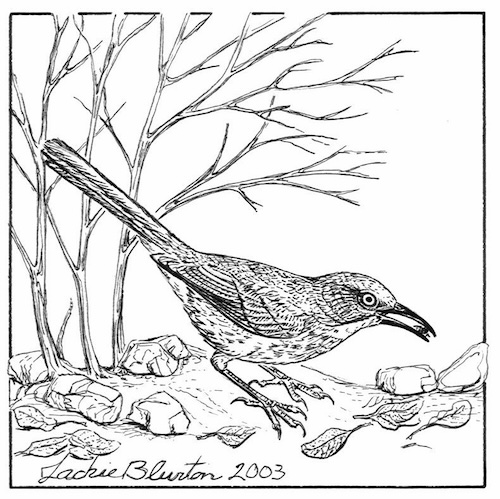 Art by Jackie Blurton
Nature Note by Dr. Roland Shook
Thrashers belong to the family Mimidae which includes the other "mimics" such as mockingbirds and catbirds. Most species of thrashers are found primarily in the Southwest. All have curved bills except the Sage Thrasher, but the bill of Bendire's Thrasher is nearly straight. The Curve-billed Thrasher is the most common desert thrasher in the Southwest. This species can be told in the field by its strongly curved bill, mottled breast, and pale orange eye. The juveniles seen in late summer have a straighter bill, yellow eye, and a breast with more pronounced spotting. These young birds are often confused with Bendire's Thrashers.
In our area, Curve-billed Thrashers often nest in seemingly impenetrable branches of cholla. They often position their nests in the middle of this thorny plant which affords protection from most predators. However, I have seen snakes solve the problems of the cholla thorns and feast onthrasher eggs.
Thrashers are often seen on the ground scratching in leaves looking for food. Insects predominate their spring and summer menu, but in other seasons seeds and fruit are the principal diets.
Roger Tory Peterson describes the call of this species as a sharp, liquid whit-wheet (like a whistle to attract attention). The song, unlike many others of this group, does not seem to mimic other species and is not characterized by repeated phrases. Peterson describes it as almost grosbeak-like in quality but faster.