








By Mike Bibb
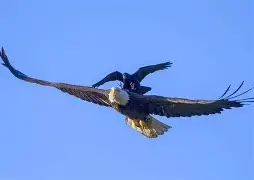 photo provided by birdhelpful.com Never gave it much thought until I came across an article on eagles and crows simultaneously scavenging a buffalo carcass in Yellowstone Park — after the wolves and coyotes had their fill.
Normally, we think of the majesty of the American Bald Eagle as one of the premier creatures on Earth. Swift in flight and deadly when in its hunting and fishing mode — which is probably one of the reasons it was selected as our national symbol.
For awhile, it was rumored Ben Franklin thought the wild turkey should be a contender for the crown because he believed the Bald Eagle "was of bad moral character."
However, in spite of the turkeys ability to survive in a harsh environment and an elusive animal to hunt, the Bald Eagle won the popularity contest.
Probably, for the simple reason it is more appealing to the eye and has a symbolic history of being an assertive figure.
After all, who fears a big bird walking around on the ground — although it is capable of limited flight. Primarily vegetarian, consuming grasses, berries and insects, a turkey will occasionally consume small rodents.
Not exactly the image a rising new nation would want to portray to the world.
That distinction was bestowed upon the Bald Eagle in 1782 — six years before Congress ratified the U.S. Constitution in 1788. A skillful hunter, fisher, defender of its homeland and a good-looking dude/dudette. Plus, it's indigenous to Canada and the United States.
A Hollywood equivalent of today's movie star, without the liberal politics to go along with it.
Incidentally, the female Bald Eagle is, generally, larger than her boyfriend — an occurrence in nature not requiring "transitioning" surgery and medication to achieve.
Nevertheless, they're both the perfect personification of the new kid on the block; puffing up his chest, flexing muscles and keenly looking over his turf.
At least, an appealing marketing strategy before we had strategic missiles and long-range stealth bombers capable delivering nuclear explosives that can turn sand and soil into glass in a milli-second.
So, who, in their right mind, would intentionally provoke a large bird of prey, with a wingspan up to seven feet, and expect to live and brag about it?
A crow/raven.
Crows are everywhere — about as ubiquitous as house flies. You'll see them scrounging in recently plowed farm fields, hanging around landfills, cleaning up roadkill, cruising overhead reconnoitering the area for a tasty morsel, or perched in a tree, squawking about something.
They've been depicted in literature and movies as being representative of evil, or an omen of future unpleasant events.
Probably, because of their large size, shiny black color, long pointed beak, harsh loud chatter and — like vultures — always seem to be present around deceased animals.
Still, the question is, can crows intimidate Bald Eagles?
Not certain it is intimidation more than posturing. If an eagle ventures close to a crow's nest, the crow will instinctively react to protect its home and family.
Just as an eagle would do in similar situations.
They are not natural enemies, only rivals in an ecosystem that supplies the necessary food to sustain the creatures dwelling within it.
And, when necessary, help keep it clean.
The fact they may be seen together devouring remains of wildlife or a domestic animal run over by a car, is not really unusual. They're more interested in the meal than each other.
In Yellowstone or most any other place, Nature's Law usually prevails: The "Big Ones eat the Little Ones" — and anything else they can find.
Except, maybe in the jungle rivers of South America, where the omnivorous piranha fish eats just everything available.
I'm not sure a Bald Eagle would tangle with those guys, recognizing a misjudgment in his fishing skills could cause serious damage to his much admired physique.
Otherwise, eagles are eagles and fish are fish — usually the two only meet at lunch time!!!