








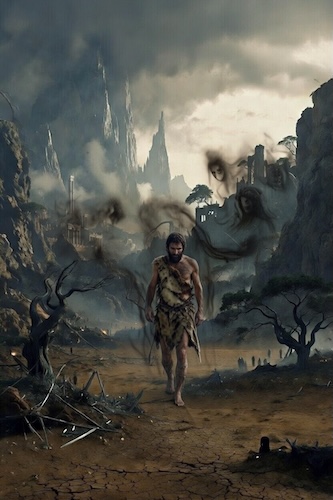
Image by Grok
East of Eden
How Far Have We Wandered?
Genesis 4 — Adam had known his wife Eve, and she conceived, gave birth to Cain, and said, "I have gotten a man with the help of the Lord." Then she gave birth again to his brother Abel.
And Abel was a keeper of flocks, but Cain was a tiller of the ground. Cain brought an offering to the Lord of the fruit of the ground. Abel also brought the firstborn of his flock and their fat portions. And the Lord had respect for Abel and his offering, but for Cain and his offering, He did not have respect. And Cain was angry, and his countenance fell.
The Lord said to Cain, "Why are you angry? Why has your countenance fallen? If you do well, shall you not be accepted? But if you do not do well, sin is crouching at the door. It desires to dominate you, but you must rule over it." Cain talked with Abel, his brother. And it came about, when they were in the field, that Cain rose against his brother Abel and killed him.
The Lord said to Cain, "Where is Abel, your brother?"
Cain said, "I don't know. Am I my brother's keeper?"
And then the Lord said, "What have you done? The voice of your brother's blood is crying out to me from the ground. Now you are cursed from the ground which opened its mouth to receive your brother's blood from your hand. From now on, when you till the ground, it will not yield for you its best. You will be a fugitive and a wanderer on the earth."
Then Cain said to the Lord, "My punishment is more than I can bear. You have driven me out this day from the face of the earth, and from your face will I be hidden, and I will be a fugitive and a vagabond in the earth, and it will happen that anyone who finds me will kill me."
So the Lord said to him, "Therefore whoever kills Cain, vengeance will be taken on him sevenfold."
The Lord put a mark upon Cain so that no one finding him would kill him. Then Cain went out from the presence of the Lord and settled in the land of Nod, east of Eden.
"The land of Nod, east of Eden"—how far east of Eden are we today? Why were Cain and his future descendants cast out from the settled land of Adam? Cain was warned by God not to fall prey to jealousy, as it would ultimately lead to even more sinful behavior. God advised Cain to look within himself for answers as to why his homage fell short. His punishment for the first murder, committed because of a depraved mind, was banishment, hard times, and perpetual fear of reprisal from others. God, in his first act of mercy, put a mark on Cain as a warning to others not to continue this cycle of sin by slaying him. For in doing so, they would be punished sevenfold! A graphic reminder that, "Vengeance is Mine, sayeth the Lord" — Romans 12:19.
If you wish to understand yourself and the world around you, read the stories, be they literal or metaphorical, of those who came before you and learn from their mistakes.
What became of Cain and his line? The Bible gives us a glimpse in Genesis 4:17-24. Exiled yet protected by God's mark, Cain takes a wife, fathers a son named Enoch, and builds a city named after him. His descendants multiply and excel in remarkable ways: Jabal fathers those who live in tents and raise livestock, pioneering a nomadic, herding way of life; Jubal becomes the father of all who play the harp and flute, giving birth to music and art; Tubal-Cain forges tools of bronze and iron, ushering in advanced craftsmanship and technology. These gifts of ingenuity, beauty, and progress echo God's own perfect creativity—for man's mind is but a reflection of God's mind.
Yet the trajectory darkens, as Cain's line does not see God's reflection, but only their own. Lamech, a later descendant, takes two wives—introducing polygamy, a twisting of God's original design for marriage—and boasts in a defiant song where he has killed a man for wounding him and claims vengeance far beyond God's mercy to Cain by declaring, "If Cain is avenged sevenfold, then Lamech seventy-sevenfold."
Worldly success flourishes—cities rise, arts bloom, technology advances—but without turning back to God, it fuels pride, violence, and self-exaltation. The mercy shown to Cain doesn't spark repentance; it becomes license for greater arrogance.
Contrast this with Seth's line, born in God's Grace for Abel, where the people begin to "call upon the name of the Lord" (Genesis 4:26). One path builds a glittering but restless civilization east of Eden; the other seeks a relationship with the Creator. Both lines reveal our potential for inventive progress and evil brokenness.
The question echoes down to us: Will we use our gifts to glorify ourselves, or to draw near to God? Will we live in a world full of human achievement while still wandering from the path of righteousness? This story reminds us that we can choose differently. Even as God's Mercy waits, sin still crouches at the door, and thou must rule over it. The real distance from Eden is not measured in miles, but the steps we take toward or away from the One who marks us not for destruction, but for eternal life—with Him.