







Image by grok
The Cowboy's Dream
One night, after a long day riding fence, a cowboy fell asleep beside his dying campfire. And as he slept, he dreamed of riding across a vast desert under an iron-colored sky. The wind carried the smell of fire and brimstone.
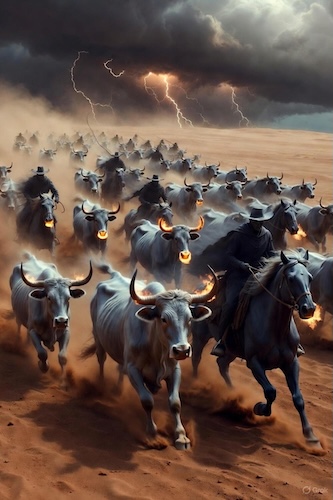
In the distance, he thought he heard thunder, but it wasn't thunder—it was the pounding of hooves coming from a herd of ghost cattle stampeding across the sky, their horns glowing like embers in a furnace. Behind them thundered ghost riders—gaunt, relentless, with eyes fixed on the horizon. Their ropes swung like lightning, their horses snorted fire, and the cowboy felt the earth tremble beneath him.
One of the riders broke from the herd and rode down toward him, pulling up just short of his horse. His voice echoed like the wind through a rocky canyon.
"These cattle are the truths men tried to tame. They tried to shape them to their liking, to make them gentle, to make them obey. But truth is not a thing a man can bend. It runs wild, and it runs real."
The cowboy swallowed hard. "Then why do you chase them?"
The rider leaned in close. "Because when men stop riding after truth, truth starts riding after them."
The cowboy looked up at the burning herd and felt a shiver of fear run through him. "Is there no way to bring them home?"
The rider pointed toward the horizon, where two trails split like a forked tongue. "One trail is solid, but narrow," he said. "It leads through rock and storm, and it will break a man before it betrays him. The other is wide and soft, and it will carry a man wherever he wishes—until he discovers it is nothing but a mirage."
The cowboy leaned forward in his saddle, "Why do men take the soft one?"
The rider smiled sadly. "Because it flatters them. Because it tells them they're in charge. Because it promises freedom to do as they please without cost."
The sky rumbled. The ghost herd turned, circling like a storm, and the rider's voice dropped to a whisper. "But the truth you surrender to becomes the truth that saves you. And the truth you try to command becomes the lie that destroys you."
As they rode on by him, he heard one rider yell: "Cowboy, change your ways today, or with us you will ride, trying to catch the Devil's herd across these endless skies!"
The cowboy awoke abruptly with the fire burning low and the stars bright above him. He shivered as the sound of hooves still echoed in his chest.
Reflection: Dreams have a way of telling the truth sideways. They slip past the defenses of the waking mind and speak in symbols older than language. The cowboy's dream is one of those visions—a revelation wrapped in dust and thunder, where the eternal law rides in the shape of ghostly cattle across a sky that mirrors judgment.
The ghost herd is truth itself: wild, untamable, indifferent to human preference. Men have always tried to domesticate truth, to make it gentle, to make it obey. They want it to flatter them, to bend to their desires, to carry them where they wish to go. But truth is not a pet. It is a force—a reality that existed before we named it and will remain long after we have forgotten our own names.
When the rider says, "When men stop riding after truth, truth starts riding after them," he is describing the moral structure of the universe. Ignore truth long enough, and it becomes the thing that haunts you. Deny it, and it becomes the thing that pursues you.
The cowboy's question — "Why do men take the soft one?" — is the question of our age. And the rider's answer is the same answer the prophets, philosophers, and saints have given for centuries: because the soft path flatters the ego. It tells us we are sovereign. It promises that reality will bend to our will. It whispers that we can have truth without surrender, wisdom without discipline, salvation without repentance. But the universe is not built that way. The Tao, the moral law—call it what you will—is not a human invention. It is the grain of the universe. To go against it is to splinter yourself. To go with it is to find life.
The cowboy's awakening is the awakening of every soul that has ever been confronted by truth. He wakes shivering, not because the night is cold, but because he has glimpsed the structure of reality. He has seen that truth is not something he can command. It is something he must pursue, surrender to, and ultimately be transformed by.
The dream ends, but the echo remains: "Change your ways today." Not out of fear, but out of recognition. Not because truth is cruel, but because it is real. And reality, once embraced, becomes the very thing that saves us.
In the end, the cowboy's dream is not a warning of doom but an invitation to alignment—to ride with the grain of the universe rather than against it. For the truth we chase becomes the truth that carries us home. This is what Jesus meant when He said, "I am the way, the truth, and the life: no man cometh unto the Father, but by me."