








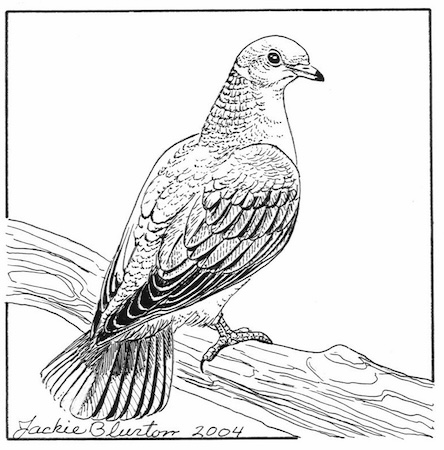
Art by Jackie Blurton
Nature Note by Dr. Roland Shook
Pigeons and doves are common names for members of the order Columbiformes. The name of the Order is derived from the Latin columba which is thought to be imitative of the cry of members of this group. In our area, you have the frequent opportunity to view Mourning, White-winged, and Eurasian-collared Doves, as well as Rock and Band-tailed Pigeons. All doves and pigeons are vegetarians and many feed on the ground in search of seeds. Most members of this group are migratory.
The Band-tailed Pigeon is an individual of the West. These birds range from as far north as British Columbia south into Mexico. Oak canyons, foothills, and mountain forest are the primary habitats of this species. It has a similar build and shape to the Rock Pigeon (formerly called Rock Dove or Domestic Pigeon) and might be mistaken for this species except for the difference in habitat and the Band-tailed Pigeon's tendency to perch in trees.
Band-tailed Pigeons can be distinguished in the field by their size, predominately gray color, a fan-shaped tail with a distinctive pale grayish band at the end, and a white crescent mark on the back of the neck. The song is a repeated owl-like hooting "hu whoo, hu whoo ...." – Sibley.
This species eats practically no insects, subsisting on acorns, fruits, and seeds. Owing to the flocking tendency of Band-tailed Pigeons in some localities roving members can be an economic problem for farmers.
Although not uncommon in our area, this species is not always easy to find. On your next outing to the mountains look and listen for North America's largest pigeon.