








By Mike Bibb
Be careful what you wish for.
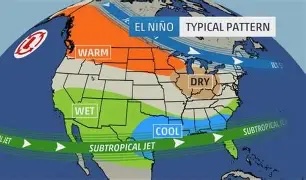 Image result for El Niño 2026 summer weather pattern picture
"A potentially strong El Niño weather pattern will likely emerge this summer and persist through the rest of the year, according to the latest official forecast by the National Oceanic and Atmospheric Administration.
Forecasters estimate there is a 62% chance that El Niño will emerge between June and August. El Niño occurs when trade winds weaken, allowing vast volumes of warm ocean water to move from the Eastern Pacific toward the Americas." — NPR, March 12, 2026
_________________________________________________________________________
"Golly, this has been the winter that wasn't" you're probably thinking. "Sure be glad when it cools down and rains settle the dust."
Careful what you wish for.
According to various weather prognosticators, El Nino is approaching and will be bringing much relief to a parched Southwestern United States.
That part of the forecast is a welcomed change from the monotonous reporting on the years-long drought we've been struggling through.
The past couple of summers have been particularly unpleasant — even by usually dry and scorching desert Arizona and New Mexico standards.
However, the big brains at the National Oceanic Atmospheric Administration (NOAA) have cautioned the 2026 El Nino may be abnormally influenced by an event that occurred in 2022.
Admittedly, I don't know how something that happened about four years ago could impact environmental and climatic conditions today, but that's what the rumor is.
Apparently, a massive undersea volcano in the far midwestern Pacific Ocean, erupted with such force and fury that its wrath is still being experienced in various ways, including the weather.
Basically, the thinking is the eruption emitted so much gas, ash, water vapor and other particulates into the atmosphere that it altered Earth's normal weather patterns, and has had a continuing influence.
Undoubtedly, caused by Trump, even though Trump didn't come around until several million years later after volcanoes began blowing their tops.
And, still do.
Gee, you mean it's not old V-8 engines, smokey fireplaces, cow farts and airplanes causing the Polar ice caps to melt and cactuses to wilt?
I had no idea, just thought it was hot.
Alas, now "climate change alarmists" have a new boogie-man — erupting volcanoes
Hunga Tonga-Hunga Ha'apai are two tiny islands formed from the explosion. The Tonga Islands are located south of the Samoa Islands.
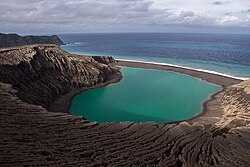 Hunga Tonga-Hunga Ha'apai islands in the mid-western Pacific Ocean
An explanation of the volcano's violence is partially explained by Wikipedia: "The most recent eruption, in January 2022, triggered a tsunami that reached the coasts of Japan and the Americas, along with a volcanic plume that soared 58 km (36 miles) into the mesosphere. It was the largest volcanic eruption since the 1991 eruption of Mount Pinatubo (in the Philippines) and the biggest explosion recorded in the atmosphere by modern instrumentation, far surpassing any 20th-century volcanic event or nuclear bomb test.[3] NASA determined that the eruption was "hundreds of times more powerful" than the atomic bomb dropped on Hiroshima.[4] It is believed that the 1883 eruption of Krakatoa (in Indonesia) is the only eruption in recent centuries that rivaled the atmospheric disturbance it produced.[5] The January 2022 eruption is the largest volcanic eruption in the 21st century.[6]"
As often the case, when Mother Nature throws a hissy-fit, it can be a humdinger, many more times violent than any man made contraption.
Volcanos come in all sizes, but most are relatively small in comparison to the terrain around them. Take a look at the Gila Mountains and Black Hills north of Safford, Arizona and the Whitlocks to the east. These are old volcanic ranges, eroded by time and weather, and considerably smaller in height and size than the Pinaleno Mountains, situated south of Safford.
10,720' Mount Graham is the crown jewel of the Pinaleno range. It is not a volcanic structure, rather an "uplift," caused from the pushing and shoving of the Earth's tectonic plates forcing material to rise vertically.
Similar mountain formations exist in southern New Mexico and are, basically, part of the same ancient geological development.
Interesting info, but what do mountains and volcanos have to do with if it's going to rain this summer?
Apparently, more than we realize, or even considered. At least, it never occurred to me that a submerged semi-active volcano, somewhere in the distant Pacific Ocean — thousands of miles away — could be a contributing influence to our El Niño weather patterns in southern Arizona and New Mexico.
As in many things, there is almost always a cause and effect. El Niño, and a couple of newly made micro-sized islands in a big ocean, are thought to be a significant factor in determining the number of inches of rain we receive in southern Arizona and New Mexico in the next few months.
On the other hand, weather gurus may insinuate a lack of moisture is because of giant solar panel farms and residential homes sucking-up all the available Sun's rays.
Could be — makes as much sense as anything else they expect me to believe.
However, when the Yellowstone caldera begins rumbling on a consistent basis, then I'll start giving serious consideration to packing my bags and moving to the serene foothills of Mount Vesuvius.