








By Mike Bibb
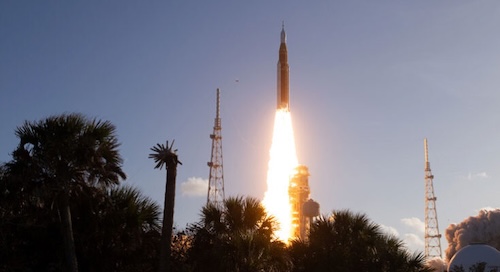
Contributed Photo/Courtesy NASA: NASA's Space Launch System rocket and Orion spacecraft lift off in this April 1, 2026, image. NASA's Artemis II mission will take NASA astronauts Reid Wiseman, Victor Glover, and Christina Koch, and CSA (Canadian Space Agency) astronaut Jeremy on an approximately 10-day journey around the Moon and back aboard their Orion spacecraft.
_____________________________________________________________________
Like the President John F. Kennedy assassination a few years prior, I remember exactly where I was when U.S. astronauts first landed and walked on the moon on July 20, 1969.
It was during the height of the Vietnam War, and I was assigned to a Marine Corps Air Station. About a dozen Marines were huddled in front of a small TV awaiting the landing of the Apollo 11 lunar module.
After announcing "The Eagle has landed," astronaut Neil Armstrong descended the spacecraft's short ladder and declared his now famous comment "That's one small step for man, one giant leap for mankind" as his uniform's boots settled into the Moon's soft surface.
That was 57 years ago, and the film clip has been reshown innumerable times.
But, not without controversy. The authenticity of that particular moon landing has been a point of contention — since, practically, the day it happened.
Many skeptics argue because of the lighting, surface features, movement of the astronauts and other issues that the alleged landing was really a staged event, filmed in a studio and released to the public in order to satisfy Kennedy's instance "I believe that this nation should commit itself to achieving the goal, before this decade [1960s] is out, of landing a man on the Moon and returning him safely to the Earth."
It's been a back-and-forth debate for five decades, and nearly as mysterious and confusing as the Kinnedy assassination.
Please, don't try to settle the issue by insisting "The government would never lie to us."
Now, over a half-century later, there's renewed interest in returning to the Moon. Except, this space voyage will not include walking on the Moon. The crew is simply going to cruise around it a couple of times and head home.
Why? We've already proven we're capable of accomplishing the task, so what's to be gained by repeating it — other than spending gobs of money?
Money, we don't have.
With a national debt of $38 trillion, an expensive war going on in the Middle East, and massive fraud schemes involving billions and billions of your tax dollars being stolen in numerous states, a rationally thinking person has to wonder "Where is the money coming from to pay for another series of Moon adventures? Rockets, landers and other space equipment don't come cheap."
I'm not nearly smart enough to answer that question because, frankly, I have no idea. Other than it probably involves increased borrowing, taxing and printing pallets of the green stuff.
And, since April 15 is a few days away, don't forget to promptly file your taxes. The IRS needs more of your money, even though it's being pissed away — or, pillaged — faster than it can be taken in.
Which means, of course, deeper in the financial hole we go.
Can $45 trillion be far away?
Not at the rate we're going.
Forget about the principle; what happens when interest payments on this debt exceed other obligations the government has?
Something has to go, because lenders want their money — while it's still worth at least 10 cents on the dollar.
Unfortunately, there's not a rocket big enough to get all of us to the Moon. Even if there was, what would we do when we got there?
Look for the nearest ATM. A cup of Starbucks probably only costs $57 up there. More, if it's delivered to your Airbnb Lunar Hut.
Sipping on the concoction, and gazing down at Earth 240,000 miles away, our thoughts may slip into a fantasy of "Damn, I forgot to inform the post office to forward my mail. Now, I'll probably get a "Late Notice" from the city utilities department telling me I have until the 23rd to pay up"!!!