








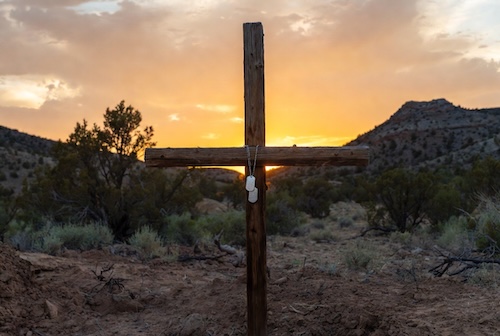
Image by Grok
Boys Who Stood Up Before Their Time
Those of you who read my musing last year about Lonesome Dove might remember Ricky Schroder playing Newt — a boy who became a man at an age when he should still have been clothed in childhood innocence. Schroder also starred in Too Young to Die, the story of Calvin Graham, a 12-year-old boy who lied about his age, enlisted in the Navy, and fought in the Naval Battle of Guadalcanal.
Every war this country has ever fought has had its Woodrow Calls — the steady, seasoned men who knew the cost before the first shot was fired. But right beside them, almost hidden in the dust-up, there have always been others like Newt — the boys who stepped forward before their time.
Calvin Graham was one of them. At twelve years old, he climbed aboard the USS South Dakota. He should have been skipping rocks or stealing his first kiss, not hauling wounded men twice his size across a burning deck while dodging shrapnel in the black water off Guadalcanal. His sacrifice was rewarded with three months in the brig, the nullification of all his medals — including his Purple Heart and Bronze Star — and a dishonorable discharge. It took three Presidents and his own funeral at age 62 before the Navy finally restored the honors he had earned as a child wearing a man's uniform. Calvin wasn't the first, and he won't be the last.
In the Revolution, 15-year-old Joseph Plumb Martin marched barefoot through snow and helped storm Redoubt No.10 at Yorktown. In the Civil War, 10-year-old Johnny Clem became a drummer boy and later fired a musket nearly as tall as he was at Chickamauga. Only God knows just how many children volunteered to fight and die in those terrible, tragic wars. One to bring a nation together, the other to keep it together.
In the trenches of France, farm kids who'd never been farther than the next county found themselves staring at a devastated landscape lit by artillery, and trenches full of rats, chemical agents, and nerve gas. There are no official cases of underage boys fighting in WW1, but because many children were born at home and unattended, you can bet there were numerous underage kids fighting one of our most barbaric wars.
During World War II, 14-year-old Jack Lucas stowed away on a transport, and at seventeen threw himself on two grenades at Iwo Jima to save his fellow Marines. He survived and received the Medal of Honor. On a personal note, my own father lied about his age and served in that same brutal island-hopping campaign in the Pacific.
In Korea, seventeen-year-old Marines of every race and creed froze in foxholes at the Chosin Reservoir and held the line in temperatures that cracked steel. In Vietnam, fifteen-year-old Marine Dan Bullock — the youngest American service member killed in that war — fell in a jungle half a world away from home. He had enlisted at fourteen. A brave black child who became a man fighting a lost cause, he came home in a body bag, just another number on the casualty list. A veteran's marker was finally placed on his grave decades later. And schools have been named in his honor in recent years — long overdue but well deserved.
And we must not forget the boys and girls who lost life and limb in the forever wars of Iraq and Afghanistan. The horror many of them endured, and the way so many have been neglected and forgotten afterward, remains a national tragedy — and a national disgrace.
Today, a new generation of nineteen-year-olds stand watch in the Middle East under the shadow of Iran's ambitions. They are old enough to carry rifles but young enough to still be figuring out who they are. They didn't ask for the world to be this way. They simply showed up when it was.
What ties them all together isn't glory or politics. It's something quieter. It's the willingness to step forward when the line was thin, and the darkness was close — because someone had to carry the light.
Most of these boys never made the history books. Many came home to ordinary lives. Some never came home at all. History may forget them, but Heaven doesn't. The God who said "Let there be light" sees every small flame carried into the wind. He sees the boys who grew up too fast and the ones who never got the chance to grow up at all. He sees the young men and women standing watch this very morning, far from home, in places where the mission is murky and the outcome uncertain.
We honor them not because they were fearless — most weren't. We honor them because they went anyway. The world is held together not just by the strong, but by the willing, not just by the seasoned, but by the young who step forward before their time. The light they carried still shines. And the Light of the World still remembers them.