








Image by Grok
Never Cut a Deal with the Devil
From The Voyage of the Dawn Treader, by C.S. Lewis (paraphrased): "Just as Eustace reached the edge of the pool, two things happened. First, it struck him like a thunderclap that he had been running on all fours—and why on earth had he been doing that? Then, as he leaned toward the water, he thought for a moment that another dragon was staring back at him. But in an instant, he realized the truth. The dragon's face in the water was his own reflection, moving when he moved, opening and closing its mouth in sync with his. He had turned into a dragon while asleep. Resting on a dragon's hoard with greedy, dragonish thoughts in his heart, he had become a dragon himself."
The often-quoted German philosopher Friedrich Nietzsche once wrote that a nihilist is a man who judges that the real world ought not to be, and that the world as it ought to be does not exist. And so, he says, all our living—our action, our suffering, our willing, our feeling—is "in vain."
That little phrase—in vain—is the heartbeat of nihilism. It is the quiet verdict that nothing matters; that meaning is a human illusion, that the universe is a self-made machine grinding on and on without direction or purpose.
But here's the irony Nietzsche himself understood—even the nihilist uses the tools of meaning to declare that meaning does not exist. He must stand on a moral platform in order to announce that there is no platform. He must use value to deny value. It is the abyss speaking through a human voice.
And when a culture begins to believe that the world "ought not to be," it becomes capable of anything. History proved this with a brutality that still echoes over time and space: Hitler, Stalin, Mao—men who believed the world had no given meaning, and so they imposed their own. They believed they could fill the void with ideology, with power, with blood.
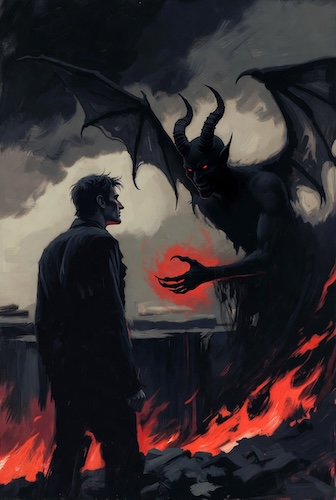
Nietzsche put it this way, "He who fights with monsters should look to it that he himself does not become a monster. And if you gaze long into an abyss, the abyss also gazes into you." The abyss is not empty, and it seeps into the heart and soul of the one who stares too long.
And now, in our own age, the abyss has gone digital. It scrolls. It pings. It notifies. It whispers the same old verdict in a new voice: "Nothing matters. Everything is noise. All is in vain." Spend enough time in that current, and you begin to feel the undertow—the thinning of hope, the flattening of joy, the quiet suspicion that your life is just another data point in a world without purpose. But here is the truth Lewis would shout from the rooftops: The world is not in vain. You are not in vain. Your suffering is not in vain. Your willingness, your feelings, your living—none of these are in vain.
The abyss is not the only thing that speaks. There is another Voice, older than nihilism, stronger than despair, gentler than the void. A Voice that says, "This world is good." "This life is meaningful." "You are made in My image." "And the Light shines in the darkness, and the darkness has not overcome it."
Put that Light behind you, and the reflection in the pool changes. The abyss loses its claim. The dragon skin loosens. The soul remembers its shape.
The soul becomes what it beholds—if the abyss is all there is, you will always be part of the abyss. But if Christ is the Light you walk in, then even the abyss becomes a place where meaning is reborn, and the world—this real world—becomes a place worth living in again.