








[Editor's Note: Apologies to author and readers. I received this on Sunday and thought I posted it, but obviously didn't. }
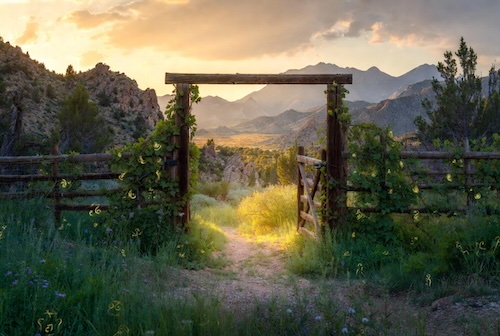
Image by Grok
The Garden and the Wilderness
In this musing, I am tracing C.S. Lewis's journey to Christianity. A seamless movement from the "backyard" of myth and longing, into the vast untamed country of revelation, without ever scorning the garden that first awakened his wonder. Lewis never saw pagan myths as rivals to Christianity, but as good dreams sent by God to a waiting world.
"The heart of Christianity is a myth which is also a fact. The old myth of the Dying God, without ceasing to be myth, comes down from the heaven of legend and imagination to the earth of history." — C.S. Lewis.
I often quote C.S. Lewis in these musings, and for good reason. Lewis was a seeker whose hunger for truth refused to let him rest. His metaphorical backyard was like a mysterious garden full of thorny but beautiful roses — a place where a man could discover eternal truths, even after the bite. But there comes a moment in every seeker's life when the familiar garden is no longer enough. The tidy paths of childhood wonder, the stories that first awakened longing, begin to morph into a deeper longing. C.S. Lewis knew that moment well.
Mythology was his backyard. He played there all his life — among the Norse winds, the Greek mountains, and the Celtic mists. It was where his imagination first learned to breathe. Yet even as a boy, he sensed the garden was not the whole world. It was only a foyer to the concert hall, where the lingering echoes of great music could be heard. For Lewis, myth was never a lie. It was revelation in seed form. Truth breaking the soil before it had a name. He believed the great stories of the nations were not mere human inventions, but human responses to something older, deeper, and more real than any culture. They were echoes of a Voice that had not yet spoken plainly.
When he reluctantly turned to Scripture, Lewis saw Genesis not as a primitive science lesson, but a mythic truth spoken with divine authority — a story carrying the Word of God in a form the earliest listeners could understand. Its strange familiarity struck him. Not because it matched modern science detail for detail, but because its order, its rising complexity, its declared goodness mirrored the very pattern the world itself obeys. How could an ancient people have intuited a universe with a beginning, a cosmos born in light, a creation unfolding in stages, unless some whisper of revelation had already reached them? He realized, almost against his will, that all the rivers of myth he had loved were flowing toward this one sea. The beauty he had tasted in the backyard garden was only a hint of the wilderness beyond — a wilderness of mountains and rivers, meadows and peaks — an infinite beauty the garden could never contain. Myth had prepared him. Revelation completed him.
Then came the New Testament. The death and resurrection. Here was a story bearing the unmistakable scent of myth — and yet the hard edges of history. The dying god of the old tales now had a name, a date, and a place. The descent into death and the rising again was no longer a mere symbol, but an event. Here was the myth that became fact. In the New Testament, myth walked into history. Not a symbol to be interpreted away, but a man who suffered, bled, and left an empty tomb. That moment in history, under Pontius Pilate, makes all the difference. Christianity is the true myth, the one that doesn't have to remain in the realm of "once upon a time."
And perhaps that is the invitation for us as well; to honor the garden where our imagination first learned to breathe; our childhood stories, our early longings, our first glimpses of wonder. But not to mistake the garden for the country. For beyond the hedge lies the wilderness of God. A world where myth becomes revelation, where longing becomes truth, and where the ancient stories find their fulfillment in a risen Christ. A world where the Creator still speaks through story, through symbol, and through the deep music of the universe.
And this is where Lewis forces us to face something deeper still. Most of us love the idea of God the way we might love the idea of a bear — majestic, powerful, stirring. But how would we react to meeting a grizzly on a narrow mountain trail? The abstract becomes immediate; the symbol becomes presence; the safe idea becomes a living reality. This is the true meaning of "God-fearing" — not terror, but overwhelming awe — the moment we realize the wilderness is inhabited, and the One who inhabits it is alive, aware, and approaching.
The garden teaches us to long for something greater. The wilderness teaches us that the longing has an object worthy of it. Many today linger on the shallow paths of consumer yearnings, political stories, or pseudo-spirituality because the wilderness realm of God carries the risk of awe, accountability, and transformation. Yet Lewis reminds us it is worth it. The One who planted the garden never meant us to stay fenced in. He left the gate open. The garden is good. But the wilderness is calling. And the One who breathed life into both still whispers through them: "Awake, O sleeper — love, think, speak. Come further up. Come further in."
"In the beginning was the Word, and the Word was with God, and the Word was God. He was in the beginning with God. All things were made through him, and without him was not any thing made that was made. In him was life, and the life was the light of men. The light shines in the darkness, and the darkness has not overcome it." JOHN 1:1-5 (ESV)