








Image by Grok
The Heart Before the Mind
C.S. Lewis once warned that modern education was producing “men without chests.” He meant that we were raising people whose reason was trained, and whose appetites were indulged, but whose affections — the seat of courage, conscience, and ordered love — were left malnourished. Lewis argued that the chest is the bridge between the head and the belly, the place where a person learns to love what is good and resist what is base. And when that bridge collapses, society collapses with it.
I’ve begun to wonder if the building of that chest does not begin in the classroom at all, but in the nursery. We live in an age that tries to build children from the top down. We fill their heads with information, giving them early literacy, early math, early screens, and early stimulation. Teaching them to name the world before they’ve learned to love it. But a child is formed from the center outward, from the chest upward, from the heart before the mind. The chest — that ancient seat of courage and affection — is not built by data. It is built by beauty.
A baby does not need to understand a lullaby to be shaped by it. The shaping happens in the tone, the steadiness, the warmth of a voice that says, “You are safe. You belong. The world is not chaos.”
A child does not need to grasp the structure of Mozart to be steadied by it. Classical music soothes the atmosphere. It teaches the nervous system that harmony is possible, that tension can resolve, that beauty has a spine. And a toddler does not need to comprehend the literal meaning of a story to be nourished by it. Stories plant seeds of wonder long before comprehension arrives. A child who hears tales of courage, sacrifice, goodness, and mystery is being apprenticed to a moral universe even before he can define a single virtue.
This is how you build a chest. Not by lecturing a three-year-old on ethics, but by bathing their earliest consciousness in music, story, rhythm, and reverence. Before they can speak, they can receive. Before they can reason, they can resonate. Before they can choose, they can love.
And perhaps this is why the earliest formation of the heart matters so deeply. Modern physics tells us that beneath the solid world of touch and taste lies a stranger country — a realm where particles behave like possibilities, where presence is relational, where reality waits to be spoken into form. The quantum world is the twilight zone between realms, the porous border where the physical thins into the spiritual, and spirit thickens into matter and energy.
It is not the spiritual realm itself, but the sieve between worlds — the place where the breath of God passes through to sustain creation moment by moment. A realm where observation becomes participation, where potential becomes actual, where the Mind of God whispers the world into being.
And children, in their unguarded wonder, live closer to that border than we do. They receive before they reason. They resonate before they analyze. Their hearts are still porous, still tuned to the deeper music beneath the visible world. Perhaps this is why Jesus said we must become like them: because the kingdom is received through a heart that has not yet forgotten how thin the veil truly is.
Not because children know less, but because they receive more. They trust the tone. They lean toward the voice. They sing before they speak. It’s up to us to respond in kind — not with baby-talk, but with songs and stories that shape the soul.
Lewis warned that a society of “men without chests” would be full of people who could analyze everything and stand for nothing. People who could name virtues but not love them. People who could define courage but never display it.
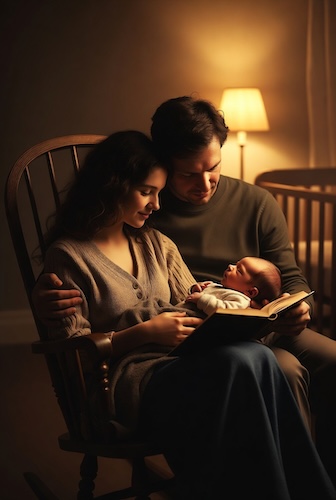
But perhaps the remedy is simpler than we think. Perhaps it begins in the rocking chair, in the quiet hours when a mother hums a tune, and a father tells a story, and a child learns — without knowing he is learning — that the world is a place where goodness is possible. If we sang more to our babies, if we filled their early days with beauty instead of noise, if we told them wondrous stories before they knew the meaning of words, we might raise a generation less hollow, less frantic, less easily manipulated, and more deeply human. Children with chests. Children who can stand tall. Children who can sing back to the world with strength and mercy. And maybe — just maybe — that is how God intended us to grow all along: not by understanding first, but by receiving the good, the true, and the beautiful until it becomes our spiritual strength.
Matthew 19:14 — But Jesus said, “Let the little children come to Me, and do not forbid them; for of such is the kingdom of heaven.”
Science can trace the continuity between consciousness and nature, but it cannot name the One who gives nature its continuity. It can describe the river, but not the spring. It can map the twilight zone between realms, but not the Light that shines through it. But we can catch a glimpse of that light through song and dance. So, let the music begin!