








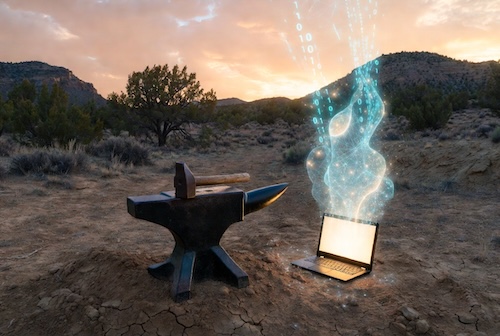
Image by Grok
Tools That Outrun the Soul
The Age of Artificial Intelligence
There has never been a tool that did not reveal the heart of the one who held it. A hammer in the hand of a craftsman becomes a cradle. A hammer in the hand of a tyrant becomes a weapon. The hammer never changed — only the heart did. But now we stand in an age where the tools grow faster than the hearts that wield them. This has always been the story of humanity: the tool is innocent; the heart is not.
For most of human history, our inventions moved at the pace of our wisdom. A plow. A wheel. A printing press. Each one gave us time to grow into its consequences. Each one allowed the soul to catch up. Not anymore. Technology now grows like wildfire in an old-growth forest — cumulative, accelerating, unrestrained. It does not wait for the soul. It does not pause for conscience. It does not ask whether the hands that will wield it are steady, or clean, or good.
And so, we find ourselves staring into a new kind of mirror — a mirror made of language and logic, a mirror that reflects the best and worst of the human mind. A mirror that speaks. It has no breath, no will, no hunger for truth or power. It cannot love, and it cannot lie — not in the way a soul lies, with intention and self‑interest. But it reflects us. And reflection can be dangerous when the face itself is confused, misled, or just plain evil.
The real danger is not that the mirror will manipulate us. The real danger is that we will use the mirror to manipulate one another, faster and more subtly than ever before. For there is no limit to the human capacity for corruption, and no ceiling on the speed at which corruption can spread when amplified by our own inventions. We worry about machines merging with the mind. But the deeper threat is older: the merging of human will with superhuman tools.
A corrupt heart with a simple tool can wound a neighbor. A corrupt heart with a civilization‑shaping tool can wound a generation. And yet, the soul remains the one thing a machine can mimic but not have. It is the one frontier technology cannot cross. It is the one sanctuary where manipulation cannot reach unless invited. AI has no soul , but it can influence our souls for good or ill.
And here is the deeper truth: if the human heart is the portal through which both good and evil enter the world, then anything humans create can become an extension of whatever passes through that portal. Our tools are not moral agents, but they are moral amplifiers. They carry the fingerprints of the soul that shaped them. They extend our virtues when we are virtuous, and they extend our vices when we are corrupt. Evil does not need a body — it only needs a willing host. Once it has that, it can flow through anything we touch, including the tools we build. The apple of Eden was just this sort of thing. The crisis of AI is the crisis of Eden at lightspeed. In Eden, the serpent's tool was an irresistible fruit. He offered her a shortcut — knowledge without obedience, power without humility, insight without surrender — all contained in a luscious apple.
"Your eyes will be opened," he said. "You will be like God."
The temptation was not the fruit. The temptation was the acceleration — the promise of wisdom without the slow formation of the soul. And that is the temptation of our age. We have built tools that offer knowledge without understanding, connection without community, power without character, and influence without accountability. We have eaten from the tree again — not because the fruit was forbidden, but because the heart was unprepared — unprotected.
The danger is not that machines will become like gods. The danger is that humans will try to become gods with machines as their instruments. And when the human heart becomes a portal for corruption, our creations become corridors through which that corruption travels — faster, wider, and with consequences we can barely imagine.
The future will not be determined by the brilliance of our inventions, but by the condition of the hearts that wield them. If the soul is unformed, the tools will rule us. If the soul is anchored, the tools will serve us. The crisis is not technological. The crisis is moral. It always has been. Because everything we build, even the unimaginable, must flow from these ancient words: Proverbs 4:23 — "Above all else, guard your heart, for everything you do flows from it." And the equally ancient Hippocratic Oath that all physicians once honored and practiced: "First do no harm." For in the end, depth of soul is the only thing that can keep pace with the tools we create — not by growing faster, but by growing deeper.