







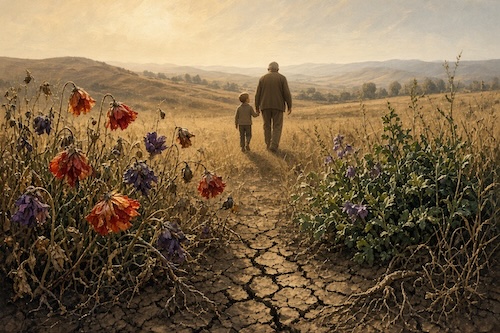
Even the Brightest Flowers Fade
Some knowledge cannot be taught; it can only be endured. The young hear it as a warning and smile politely. The old hear it as a familiar voice. Somewhere between the two, life itself becomes the teacher.
I was reminded of this while reading a passage in "Till We Have Faces." In it, C.S. Lewis writes, and I paraphrase: No one will believe this who has not lived long and looked hard, so that he knows how suddenly a passion for which has for years been wrapped round the whole of the heart will dry up and wither. Perhaps in the soul, as in the soil, those growths that show the brightest colors and put forth the most overpowering smell have not always the deepest root. Or perhaps it's simply age.
Lewis was about fifty-seven when he wrote those words, newly married to Joy Davidman and experiencing a season of profound love and companionship. By modern standards, he was not especially old, but he had lived long enough to glimpse one of life's unsettling truths: things we imagine permanent often prove surprisingly fragile. The passions that once seemed inseparable from our identity can fade. Desires that swam in vast oceans of the heart shrink into small pools of memory, and his observation made me remember a little pool of my own.
When I was twenty-one, I tended bar. In those days, I was strong, confident, and possessed of the casual invincibility that often accompanies youth. Customers frequently challenged me to arm-wrestling matches, and I usually welcomed the opportunity. One evening, a regular gambler at the bar challenged me. I beat him. Not satisfied with the outcome, he needled me into another match, this time using both of his hands against my one.
Now, youth is easily flattered and easily baited, and I took the bait.
The moment the match began, the tendon in my elbow popped like a gunshot. The room fell silent. Pain shot through my arm. Across the bar sat a man who looked to be about fifty. He had watched the whole thing unfold.
"You'll regret that when you turn fifty," he said.
I laughed and replied, "Fifty? I won't live that long! And who'd want to?"
The older man shook his head and said nothing more.
At the time, I thought I was pretty smart. Decades later, I understand that he was wise.
The years passed. Work, play, and countless unnoticed strains accumulated in the joint. Then, shortly after I turned fifty, my elbow finally demanded payment for old debts. It froze and required surgical repair. Unfortunately, it was a repair that was only partially successful in restoring my mobility, leaving me with pain and a lifelong handicap.
As I sat facing that reality, a memory rose from somewhere deep within me. I could see the barroom. I could hear the crack of the injury. Most vividly of all, I could see the expression on that older man's face.
For the first time, I understood what he had been thinking. Not that I was a fool. But more like: "This kid is in for a rude awakening down the road."
He knew that fifty arrives. He knew that youth's certainty about the distant future is an illusion. He knew that every twenty-one-year-old imagines himself exempt from the laws that govern everyone else. Above all, he knew that life is far longer than the young can imagine and far shorter than they expect. Time would make his argument for him. And it did.
Lewis's reflection and my elbow injury converge at the same point. Youth mistakes intensity for permanence. We assume that whatever burns brightest must also last longest. Yet life repeatedly demonstrates otherwise. The loudest passions often fade. The strongest bodies weaken. The convictions that once seemed immovable are tested. The competitions we thought mattered become little more than stories.
The deeper things are usually quieter. Character grows beneath the surface. Wisdom takes root in disappointment. Love often matures after excitement has faded. Faith survives seasons when emotion does not. What endures is rarely what dazzles.
Lewis wondered whether the brightest flowers may not have the deepest roots. Age, I think, tends to confirm his suspicion. The years function like a drought, revealing what was sustained merely by favorable weather and what was drawing life from deeper sources.
That is why old age, despite its losses, carries gifts unavailable to the young. It grants perspective. It allows us to distinguish between what merely colored our lives and what actually anchored them.
I still remember the arm-wrestling match. I remember the injury. But I cannot remember who was watching, or even the other man's name. Those details have withered away. What remains is the lesson. The older man was right — Lewis was right.
Some truths can only be believed after enough years have passed, enough passions have faded, and enough bright flowers have withered to reveal the roots beneath. Only then do we discover what was temporary, what was permanent, and how often we confused the two.