








Art by Jackie Blurton
Nature Note by the late Dr. Roland Shook
Mushrooms are the visible fruiting bodies of fungi. The vegetative part grows mostly underground or hidden in some other substrate. Fungi lack chlorophyll and therefore they lack he ability to capture sunlight and turn it into organic matter. Because of this, fungi usually get their energy and nutrients from dead organic matter. However, there are several parasitic fungi.
Those who study fungi have found that the vegetative part of the plant often forms mutually beneficial relationship with the rootlets of trees and shrubs. The fungi can provide the tree with phosphorus, nitrogen and other nutrients while the plant provides the fungi with moisture and protection.
The fruiting bodies of many fungi are edible. However, there are many mushrooms which are poisonous. Hence the old maxim, "All mushrooms are edible, but poison mushrooms are only edible once!"
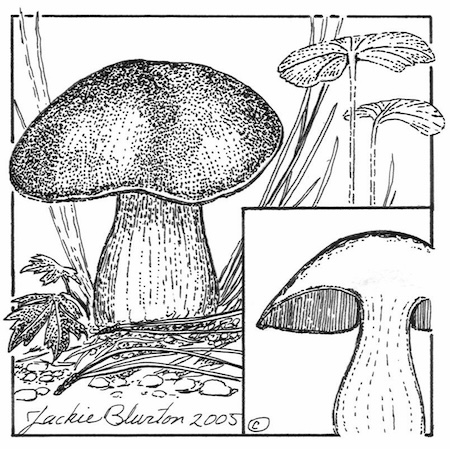
Jackie shares the following information about this edible species of fungi: Boletes are easily identified. Instead of gills, they have tubes that resemble and feel like a sponge. A variety of Boletes species can be found in the Gila National Forest. The most prized of this family is Boletus edulis, the King Boletes, which can be found in the Gila generally at 8,000 feet or higher. It has a firm domed 4-to-5-inch cap, cream-brown to a maroon red in color, with firm white flesh. The stem is large and bulbous.
Even eatable mushrooms can have harmful bacteria and must be properly prepared. Always be sure of your identification and practice safe preparation.