








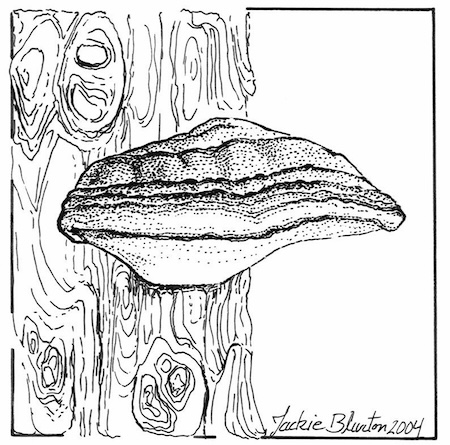
Bracket Fungi
Art by Jackie Blurton
Nature Note by the late Dr. Roland Shook
Bracket Fungi includes tough shelf-like growths on the trunks or limbs of dead or dying trees. Because these fungi live for several years, they are the most obvious group of fungi found in the woods of North America.
What is seen is the fruiting body, called "conks." The hidden mycelium or vegetative body is within the tree. Conks of some species can grow to be 3 feet wide and 8 inches thick. The concentric lines or striations at the top of the conk represent successive years of growth. Ages of 50-70 years have been recorded for some species. The bottom surface of the conk is composed of minute pores which release large numbers of spores. Large conks may liberate a billion spores per day for six months, i.e., approximately 5 trillion spores annually.
Bracket Fungi belongs to a group of fungi called polypores. This group is very important as saprophytes on dead logs, limbs, and stumps. Their relentless work gradually breaks down the wood of these former plants, uses the energy stored within, and recycles the nutrients back into the soil. A few forms can be parasitic on living trees leading to the death of these trees from root rot. Some members of this group choose to infect the wood used as lumber, digesting away the cellulose and leaving behind the lignin, these cause a condition known as "brown rot," Others digest both the cellulose and lignin causing a condition known as "white rot," or "dry rot."
On your next walk through the woods look for these interesting organisms.