







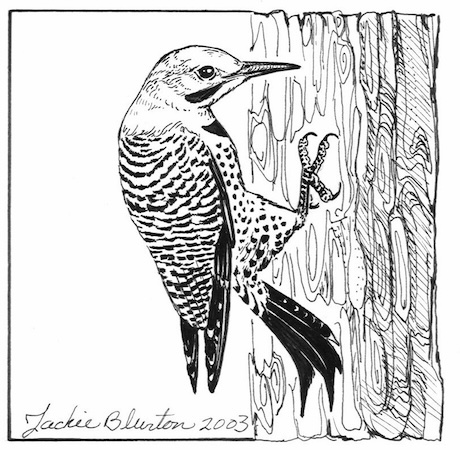
 Northern Flicker
Art by Jackie Blurton
Nature Note by the late Dr. Roland Shook
Flickers, meaning "one who strikes", are relatively common woodpeckers in our area throughout the year. Woodpeckers as a group, are adapted to extracting grubs and burrowing insects from beneath the bark of trees by using their chisel-like bill and long probing tongue. However, flickers are often seen on the ground in open areas feeding on ants. Their bright wing feathers and white rump patch make them easily recognizable.
This species was once considered to be composed of two species, the Red-shafted and Yellow-shafted Flickers. With the westward march of the earlier settlers and the planting of trees across the Great Plains, members of the former Red-shafted group found in the west were able to encounter the eastern, Yellow-shafted group. Owing to extensive interbreeding across much of North America, ornithologists reclassified them, thereby lumping the two species into one. In our area we primarily see the former Red-shafted Flicker, but some intermediates and some Yellow-shafted Flickers are occasionally noted.
This species occurs from the tree limit in Alaska and Canada south to Nicaragua. In the Fall populations of this species swell along the Gila River as some members descend to lower elevations to spend the winter, only to ascend back to their breeding grounds the next spring.
Jackie's note: This is a common and welcomed bird in our gardens throughout the year and easily recognizable in flight by the white rump patch and bright red under its wings and tail in flight. It has a black bib, red mustache, zebra striped back and back dots on its breast. A very well-dressed bird. Its call is a loud wicka-wicka-wicka-wicka.