








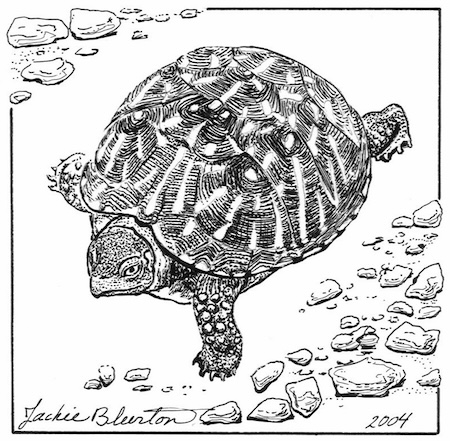
Western Box Turtle
Art by Jackie Blurton
Nature Note by Dr. Roland Shook
Box turtles can completely enclose themselves in their shells. The front of the lower shell, or plastron, is hinged and can be drawn up tightly a
gainst the upper shell or carapace. This species of turtle occurs in suitable habitats from South Dakota, through southern Indiana, south to the Gulf Coast of Texas. From east Texas, it ranges across New Mexico and southeastern Arizona and Sonora.
This land turtle is primarily a prairie turtle. Over much of its range it occupies treeless plains of grass or low shrubs and sandy soil. This species is usually not found in dense woodlands, mountain slopes, or elevation above approximately 6,500 feet. Although active during parts of the day, Western Box Turtles are most often seen crossing highways where its hard shell provides little protection from large vehicles.
In addition to enclosing itself in its shell when threatened, it also employs snapping jaws and copious urine as a defense against predators.
Western Box Turtles feed on a variety of food sources including insects, melons, tender shoots, and leaves. They often emerge from a burrow in the morning, bask in the sun, feed, and then return to their burrow where this behavior is repeated around dusk.
"This species has an odd courtship pattern. The males chase the female, if a turtle may be said to 'chase'; on reaching her, he raises himself on his hind legs and hurls the front of his plastron at the rear of her carapace, emitting meanwhile from each nostril a stream of fluid which he sprays on her back. After half an hour of such wooing, the female yields." — H. H. Collins