








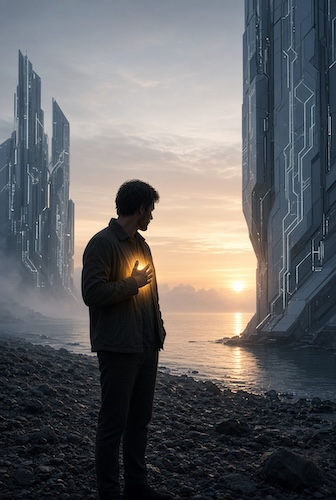
Machines Versus Souls
A strange quiet settles over the world before dawn—the kind that makes you wonder whether the world is holding its breath. And as the sun rises this morning, I find myself thinking about the newest fear making the rounds: that artificial intelligence will rise up, take over the world, and make slaves of us all. It's a compelling story. It has the drama of Revelation without the humility. But I don't think the machines themselves are the danger. I think the danger is the spirit that builds them.
Tristan Harris — the tech ethicist who's been warning Congress and anyone else who will listen — keeps saying that AI doesn't invent new evils. It amplifies the ones already present. It is a mirror, he says, a magnifier, a kind of industrial-strength echo chamber for whatever intention animates the human heart. And when I hear him say that, I hear an older voice beneath it. Because Scripture has been saying the same thing for thousands of years.
Human beings have always summoned powers they could not shepherd. We built towers in Babel, chariots in Egypt, empires in Rome. We forged tools that made us feel like gods, and then we bowed to the tools we forged. We have never been destroyed by our inventions. The motives behind their use have destroyed us. AI is simply the newest tower, built not with bricks but with chips.
Harris warns about runaway systems — machines that optimize without conscience, accelerate without wisdom, and pursue goals that leave human dignity in the dust. But that is not a technological problem. That is a spiritual one. It is what happens when a people forget who they are, forget what they love, forget the One in whose image they were made. Machines have made our lives more comfortable — maybe too comfortable. But machines are not the problem. We are.
Augustine called it ordo amoris — the right ordering of love. When love is disordered, everything downstream becomes disordered with it. Nations driven by fear build fearful machines. Nations driven by pride build prideful machines. Nations driven by domination build tools of domination. AI is not the threat. AI is the incarnation of our desires.
And so the question is not, "Will the machines enslave us?" A better question is, "What are we already slaves to?" The answer is simply power, efficiency, comfort, and the illusion of control — the terror of insignificance. These are the spirits that haunt our age, and AI will not cast them out. It will simply give them a louder voice.
But there is another spirit — older, quieter, stubborn as dawn — that machines cannot imitate, no matter how many parameters they are trained on. And this brings me to the most truly human trait: empathy. Empathy is the one thing that recognizes the full range of heaven and hell carried quietly in every life. No man needs to descend into Dante's circles to find torment, nor ascend into Milton's firmament to taste glory; the raw material of both already lies within the heart. The difference between one person and another is never in kind, only in degree.
To be human is tragedy enough — and comedy enough, too. Empathy is simply the courage to acknowledge this shared magnitude, to see that the neighbor's grief is not smaller than mine, nor his joy less radiant. It is the refusal to underestimate humanity, the refusal to believe that suffering is rare or that hope is cheap. Empathy is the reverence we owe one another as fellow travelers who bear the same vast interior landscape, each of us walking with our own measure of suffering and joy.
And that is something a machine can never feel, because machines cannot feel anything. They can calculate. They can predict. They can imitate. But they cannot stand before the mystery of another soul and truly say, "I feel your pain."
This is why the hope of our age is not technological but human. If technology magnifies whatever spirit governs humanity, then humility still matters. Mercy still matters. Truth still matters. Repentance still matters. The smallest act of love still matters, because it shapes the world the machines will amplify. Algorithms do not write the future. Hearts write it. And hearts can still turn.
So this morning, as the world wakes and the sky is blushed with first light, my hope is not for safer machines, but for truer loves. And my prayer is for a people who remember that wisdom is older than innovation, that humility is stronger than power, and that the image of God is not something a machine can erase.
If we recover that, soulless AI machines will not destroy us. They will simply become tools again. And tools, in the hands of the humble, have always been enough.
If our tools become our masters instead of our servants, it will be because we allowed them to amplify the fallenness of our nature instead of the God-given grace within the soul of every human being.