







 Reflections on Liberty and Faith
Once upon a time, long ago, there existed a people conceived in liberty. They believed their freedom came not from kings or parliaments but from natural rights endowed by nature's God. They looked upon the intricate order of the world — intelligible and morally charged — and recognized that such order implied a Lawgiver. And because they believed in a divine moral order, they believed human government must be accountable to something higher than human will.
Such as these were the early American colonists who attempted, with all the limitations of fallen men, to craft a government worthy of the self-evident truths stamped upon the human soul. They compromised where they had to, argued where they must, and built a constitutional framework that could endure the storms of history. One of their greatest insights was the amendment process — slow, deliberate, resistant to fads — a safeguard against the passions of the moment and the ambitions of the powerful.
In January 1776, Thomas Paine published Common Sense, a pamphlet that ignited the imagination of the American colonists. Later that same year, as the Continental Army staggered under defeat and desertion, Paine wrote The American Crisis. Its opening lines — "These are the times that try men's souls. The summer soldier and the sunshine patriot will, in this crisis, shrink from the service of their country; but he that stands by it now, deserves the love and thanks of man and woman. Tyranny, like hell, is not easily conquered; yet we have this consolation with us, that the harder the conflict, the more glorious the triumph." Washington had those words read aloud to his freezing, exhausted soldiers before the crossing of the Delaware. Hope and virtue — Paine said — were the only things that could survive such a winter. And somehow, they did.
Liberty, of course, is not license. A free people must still govern themselves — not only by laws but by conscience, tradition, and moral restraint. The Founders understood that liberty without virtue collapses into chaos, and chaos invites tyranny. They drew from Judeo-Christian morality, Greek philosophy, and the hard lessons of history. They knew that a society that abandons its moral inheritance will eventually abandon its freedom as well. This understanding should fill us with pride and a shared responsibility to uphold these principles.
Today, we face a different kind of trial — not merely a winter at Trenton, but a spiritual, cultural, and civilizational struggle over the meaning of truth, responsibility, human dignity, and the very preconditions for ordered liberty. Many of our institutions are strained. Many of our cities are troubled. Many of our neighbors feel unmoored. And beyond our shores, the world is under threat from radical Islam — an ideology that, in its most extreme forms, rejects the very foundations of Western liberty. These challenges call us to moral renewal and shared responsibility.
Consider Iran: 92 million people ruled by an Islamist sect that is both oppressive and barbarous, pursuing nuclear weapons while chanting "Death to America" and "Death to Israel." Data and common sense align on this: the hard-core radicals who actively support the annihilation of Western civilization form a committed minority — roughly 10-25% of the population. They rule with an iron fist through patronage, surveillance, and indoctrination. At the same time, large majorities of Iranians, especially the young and urban, show deep discontent with theocracy and desire greater freedom. Yet this minority's control, amplified by proxies across the Middle East, creates a real danger. Similar patterns hold in other pockets of the Muslim world. Small, dedicated groups have always been able to seize and wield disproportionate power when majorities are fragmented or fearful.
This reality sharpens the test for America. Why have we allowed tens of thousands — cumulatively millions — of immigrants from Muslim-majority countries, including terrorist-prone regions, to enter through lax borders, asylum loopholes, chain migration, and imperfect vetting? Common sense demands we confront the problem: while many flee the very radicals we oppose and become productive Americans, large-scale inflows from societies with widespread support for the barbarous practice of Sharia not only resist assimilation but encourage infiltration. Europe's experience with parallel societies, terror incidents, and eroded social trust stands as a stark warning. The United States has fared better, but data shows risks skyrocket when numbers outpace assimilation.
The Founders warned that the Constitution was made for a moral and religious people — that it presupposed a citizenry capable of self-restraint, courage, and reverence for the sacred. When a nation drifts from its moral North Star, its laws and borders drift with it. Importing attitudes fundamentally at odds with our inheritance risks diluting the virtue and cohesion required for liberty to endure. A self-governing republic must control its demographic destiny, prioritizing compatibility, merit, and cultural continuity alongside compassion. Distinguishing individuals of good character from ideological threats is not bigotry — it is the responsible exercise of sovereignty.
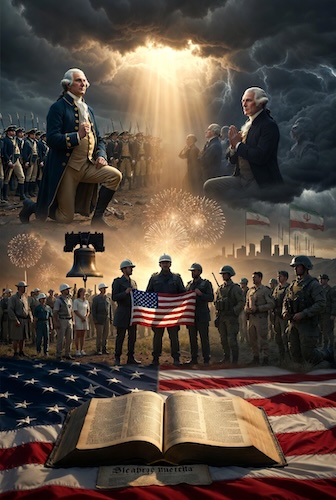
Yet the story of America has always been one of renewal. Again and again, in moments of crisis, ordinary citizens have rediscovered the principles that birthed this nation: faith, liberty, sacrifice, and moral courage. Perfect men did not win the Revolution. It was won by imperfect men who believed that freedom was worth the cost. They pledged their lives, their fortunes, and their sacred honor — not to a party or a personality, but to a truth they believed came from God —that our rights come from our Creator, not from government. Christ Himself placed this choice before humanity. And every generation must decide anew whether it will walk in the light of truth or in the shadow of deception.
This history should inspire us to renew our moral resolve today. For on this Fourth of July, we stand at another crossroads where our shared values of virtue, responsibility, and truth must guide us, or risk ever more division and chaos.
So let us honor the sacrifices of our forebears not only with fireworks, but with a renewed commitment to the principles that made this nation possible. Let us be a people formed by faith, anchored in moral clarity, courageous enough to defend the dignity of every human soul — and wise enough to secure the inheritance for those who will carry it forward. Liberty is not inherited automatically. It must be chosen — and chosen again — by each generation.
If we choose comfort and procrastination over vigilance and participation, we will wake up in the not-so-distant future to the dystopian vision of America that President Reagan warned of: "Freedom is never more than one generation away from extinction. We didn't pass it on to our children in the bloodstream. It must be fought for, protected, and handed on for them to do the same, or one day we will spend our sunset years telling our children and our children's children what it was once like in the United States where men were free."