








The Black That Makes the Grey Darker
There are moments in history when the curtain is pulled back, not by prophets or poets, but by bureaucrats, technicians, and men in lab coats, who never think in terms of souls. COVID was one of those moments. Not because of the virus alone, but because of what it revealed: the machinery behind the world, churning in the darkness, indifferent to the people it was built to serve. The people who are now nothing but lab rats.
We learned that the line between government and industry is not a line at all, but a braid. We learned that "public health" can be weaponized into fear, obedience, and profit. We learned that the institutions meant to guard life can become the very engines that endanger it. And we learned that when the powerful make catastrophic decisions, they rarely pay the price — the victims do.
People died — not only from the virus, but from the loneliness, the shuttered clinics, the missed diagnoses, the despair, the economic ruin, the spiritual suffocation. Those deaths do not appear in the official tallies, but they are written in the margins of every family that lost someone who should still be here.
And behind it all was a kind of hubris that deserves the old words — the biblical ones — because modern language is too thin. Gain‑of‑function research is not merely reckless. It is a violation of the created order. It is man reaching into the machinery of life with unclean hands, reshaping what he does not understand, and calling it progress. It is Babel with test tubes and centrifuges.
The world is grey, but only because black and white have been mixed. That's true. But the grey is darker now. Something was injected into the world — not just a virus, but a kind of moral toxin. A revelation of how easily human beings will trade truth for control, compassion for compliance, and humility for the illusion of mastery.
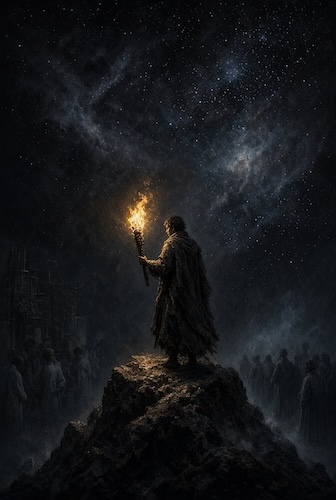
And yet — it ends with a truth that cannot be dismissed: If life is rare within the cosmos, then life is precious. If consciousness is fragile, then consciousness is sacred. If we are alone in the cosmic night, then we are the torchbearers.
The darkness is real. The betrayal is real. The evil is real. But so is the responsibility.
We cannot undo what has been done. We cannot unmix the grey. But we can refuse to let the black spread unchecked.
We can name what happened. We can guard what remains. We can carry the treasure of life — bruised, battered, but still burning — into the night.
Because if the universe is cold rock and burning gas, then the fact that we are here at all is God's greatest miracle. And miracles, as Genesis 1:26-28 makes plain, demand stewardship. Stewardship involves ethical decision-making that reflects the character of the One whose image we bear.
The above musing is inspired by my personal experience with this widespread medical malpractice. Someone close to me — a man and his wife — were victims of the worst kind of institutional abuse when they trusted the medical establishment to "first do no harm."
They were told, like millions of others, that there was no viable treatment and to stay home until they could not breathe. Only then, they were told, would the hospital admit them and place them on a ventilator — despite decades of medical consensus warning that extended ventilation causes lung damage. They were also given Remdesivir, a drug later acknowledged to cause organ failure, especially in the kidneys.
Both were eventually brought to the hospital gasping for breath. And here is the bitter irony: this very hospital was already administering monoclonal antibody infusions in the emergency room — a treatment that gave many patients near‑immediate relief. But once admitted, hospital policy forbade it. Why were they not given the infusion before admission? Why was the lifeline withheld?
After a week, their son told me the doctor admitted giving them Remdesivir "only for one week, because it could cause organ damage." Tell me it ain't so!
The tragedy is that they were essentially captured by the system — isolated, powerless, treated like prisoners of war. One died. The other emerged alive but broken — on dialysis, unable to walk, carrying bitterness that barely scratches the surface of what was done to them.
This is the black that makes the grey darker. This is why stewardship matters. This is why truth matters. This is why we must bear the torch into the night.