








Two Ways to Love
In last Sunday's musing, I said that every one of us is a beggar — stripped by time, humbled by disappointment, reduced by the slow erosion of strength and certainty. Now I want to add the next truth: God's love is complete because it is already divorced from detail.
Human love is detail-driven. God's love is essence-driven. Human love looks at the person and asks, "Why should I love you?"
God's love looks at the person and says, "I love you because I am love."
C.S. Lewis once said: We love the wise, kind, and beautiful because we need them. We love the foolish, broken, and disagreeable because they need us.
The first love is natural. The second is divine. The beggar is the test of which kind of love we carry.
Today's musing harkens back to a time in the early seventies when I was exploring the mysteries of Eastern philosophy and mysticism. What I am about to share today is inspired by something I found among some of my old papers that contained what might best be called — "deep doodling." I have no idea how it managed to survive more than half a century of my scattered life, but there it was, a visual diagram of a young mind in search of answers to questions that seemed to have no answers.
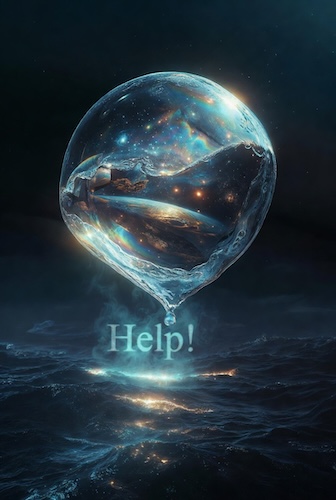
The drawing depicted a large bubble symbolizing the known universe, floating above a vast ocean, with a single droplet poised to fall from the bubble into the sea. The bubble had emerged from the churning waters, and the droplet dripping from the bubble was about to return to its origin. And the cry from the droplet was one word —"Help!"
A circle is the simplest symbol of completeness — the "closed system," the tidy cosmos of textbooks and telescopes. But I didn't draw it as a perfect Platonic sphere. I drew it wet. A wet universe is a dependent universe fed by something deeper. A universe that was not self-contained by the sterile cosmology of midcentury materialism. The sea was under the bubble, not around it. I placed it under the universe, like a womb, like the abyss of Genesis, like the waters over which the Spirit hovered.
The unknown is not elsewhere — it is under everything. That thin layer of water on the bubble's surface — evaporating from the sea and condensing on the universe — was a metaphor for consciousness, myth, intuition, and spiritual perception. An interface where the deep touches the measurable. It is the place where stories, dreams, visions, and metaphysical intuitions condense into human experience.
And it is fragile. Which brings us to the most haunting part. A single droplet, clinging to the rim, crying "Help!" It is the voice of the mystic, the philosopher, the poet, and the child who hears the ocean before he hears the world. It is the voice of someone who realizes: "I came from the deep, and I am about to fall back into it. And I don't know whether it is the emptiness of death or a homecoming."
That drop is the human condition. It is the soul recognizing its origin and its destiny — terrified because it remembers the sea but cannot quite comprehend it. And now, decades later, I still have an itchy feeling that we are swirling around in a soup of reality we have only just begun to understand.
The truth is, reality isn't solid — it's more like a broth, a membrane, a living bridge between the seen and unseen. I've always felt like that droplet resting on the bubble above the soup, aware of both worlds at once. And if that soup is an ocean of divine love from a forgiving God, then I need that love — a love beyond the details — we all do!