







The Bliss Building Wasn't the Problem. It Was the Symptom
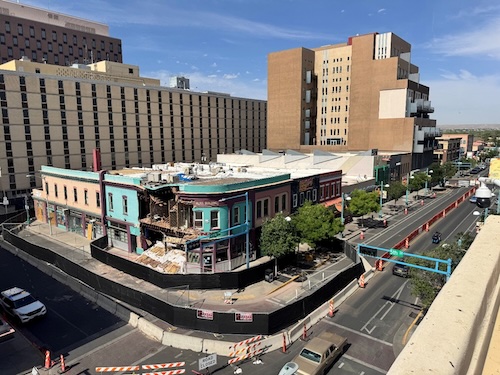 Photograph by Mick Rich
Most people understand that it takes years of hard work for a city or state to consistently rank among the nation's best. What many fail to recognize is that it also takes years of policy decisions, government actions, and unintended consequences to consistently rank near the bottom.
That is where Albuquerque and New Mexico find themselves today.
Ironically, many of the elected and appointed officials working hardest to solve our problems have, through years of well-intentioned policies, become part of the reason those problems persist.
My first night in Albuquerque, in 1980, was spent just a couple of blocks from Route 66 and Rio Grande Boulevard. During the decades since, I have watched city leaders unveil one redevelopment plan after another to revive Route 66 and downtown Albuquerque. This week, those efforts reached another milestone with the demolition of the historic Bliss Building.
The Bliss Building represented exactly the type of mixed-use development urban planners have promoted for the past two decades: shops and restaurants on the ground floor with apartments above. On paper, it was the vision for a vibrant downtown.
What planners failed to anticipate was the impact of allowing homeless encampments, open drug use, public urination, and public defecation to become accepted features of the surrounding streets. When customers must walk past people sleeping in doorways or businesses repeatedly clean up after illegal activity, commerce suffers.
As businesses struggle, property owners cannot collect enough rent to maintain their buildings. Deferred maintenance grows, property values decline, structures deteriorate, and eventually demolition becomes the only economically viable option. Rather than asking why the investment failed, the government too often places the blame on the property owner instead of examining the public policies that made success increasingly difficult.
Unfortunately, the problem extends well beyond downtown Albuquerque.
Nearly a year ago, I visited a property owner along Route 66 in Carnuel who had purchased a neglected parcel with the goal of restoring it. He was cleaning the property, investing his own money, and bringing several fifty-year-old homes back into compliance.
When I returned last week, I expected to see more progress. Instead, I witnessed a Bernalillo County code enforcement officer arrive with three Bernalillo County Sheriff's deputies. The official was not there to encourage rehabilitation or discuss the improvements already underway. He made it clear that his objective was to begin the process of demolishing the homes as quickly as possible.
What struck me most was that the homes were vacant and posed no immediate danger to the public. They had already withstood more than fifty years of New Mexico weather, including the powerful winds of Tijeras Canyon. Were they perfect? Certainly not. Were they consistent with today's million-dollar homes in Carnuel? No. But that should not be the standard by which the government decides whether a structure deserves to survive. The official reportedly described the homes as an "eyesore." An eyesore is a matter of opinion. Public safety should be a matter of evidence.
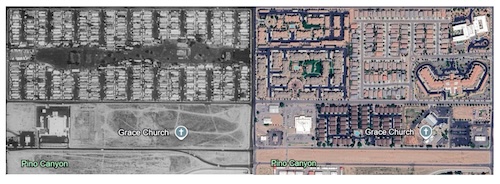 Yesterday's Affordable Mobile Home Park Today's "Resort Lifestyle Living"
Albuquerque once had numerous mobile home parks along Route 66 that provided affordable housing for working families and people living on limited incomes. Over the years, many of those parks have disappeared, often replaced by redevelopment projects based on the belief that the city had outgrown manufactured housing.
But where were those families supposed to go? To newly constructed apartment complexes that many cannot afford? To government-subsidized housing with waiting lists? To apartment complexes where police are frequent visitors? Too often, the answer has been nowhere. Many ultimately end up living beneath freeway overpasses, in business doorways, or on downtown sidewalks. On the surface, the government claims to be helping. In reality, many struggling families are increasingly left to fend for themselves.
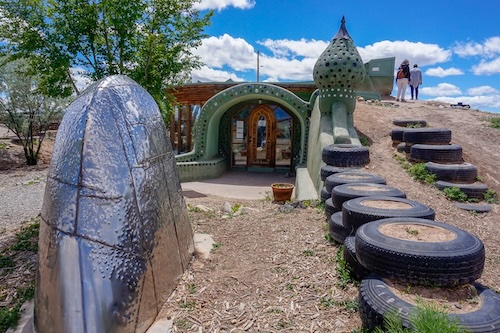 A Taos Earth Ship Home Built One Tire at a Time
The situation reminds me of the Earthships near Taos. Those unconventional homes, many built decades ago, fall outside traditional construction methods. I would not personally choose to live in one, just as I would not choose to live in many of the homes on the Carnuel property before renovation. But personal preference is irrelevant.
The real question is whether the government should default to demolition rather than rehabilitation simply because a property no longer reflects current design standards or neighborhood expectations.
There is an old investment saying:
"The time to buy is when there is blood in the streets."
Today, that phrase carries a different meaning in Albuquerque. The blood is not only that of crime victims. It is also the financial blood of business owners, property owners, and investors whose livelihoods have been damaged by policies that often produce results opposite of those intended. Cities rarely decline overnight. They decline one ordinance at a time. One zoning decision at a time. One redevelopment plan at a time. One unintended consequence at a time.
If Albuquerque and New Mexico are ever going to reverse course, we must first recognize an uncomfortable truth: Good intentions are not public policy. Good outcomes are.
Government should ultimately be judged not by the promises it makes or the intentions it declares, but by the results it delivers. After decades of declining rankings in crime, education, economic opportunity, and public safety, it is time to ask whether the policies themselves—not simply their implementation—need to change.