








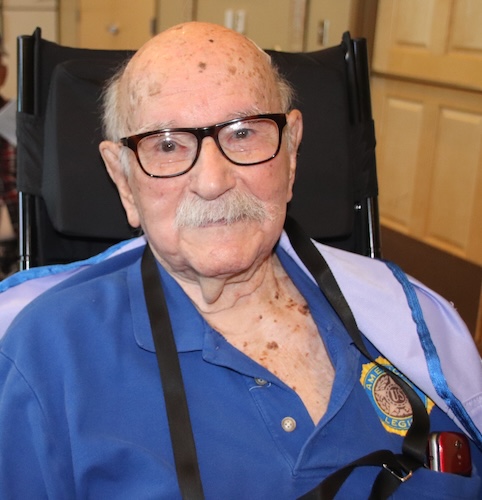
 Bill Harrison at his 104th birthday party
James William Harrison, better known as Bill, is a Navy veteran of World War II. Born on June 22, 1922, he celebrated his 104th birthday with an Episcopal service on Sunday, June 21, in the chapel at Fort Bayard Medical Center, where he lives now.
His church family, including the Rector Tara Soughers and deacons and musicians joined Harrison to celebrate his birthday
Every birthday must have a birthday cake and two choices were offered to the attendees, Harrison's favorite carrot cake, and a chocolate cake, both with vanilla ice cream.
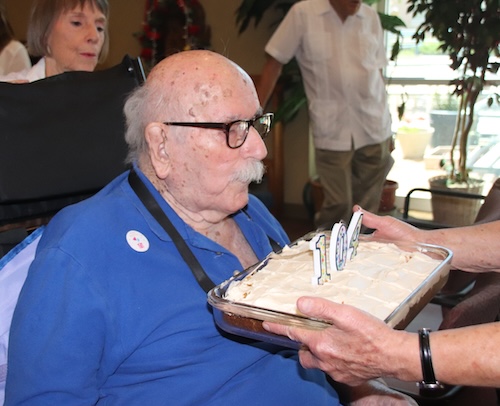 Harrison blowing out the 1 0 4 candlesHe blew out the three candles, a 1, a 0 and a 4, as everyone sang Happy Birthday.
Harrison is known for his story telling, and he mentioned at the service that he had thought about being a pastor, but decided he was too much of a hypocrite with God, so he became a lawyer instead.
"I want to thank you all for coming out here today," Harrison said of Father's Day. He said he has three children, a son and two daughters.
He thanked everyone for all the love they have given him "all these years. You know, when you get as old as I am, you get a little sentimental, and it's a great opportunity to express the sentiment and the love I have for you people for caring for me when I'm not useful to anybody for anything anymore. I thank you for providing this place, for I know that it's through the goodness of the heart of people that I'm here. They're good to me here, they are wonderful to me here. You know, it's not a feeling that I just live here, I belong here, and it's a great feeling that at my age I have a place that I can call home. This is my home."
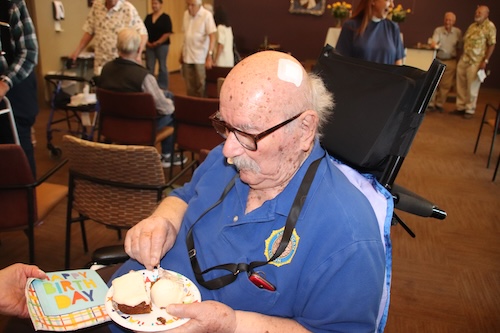 Enjoying carrot cake and ice cream.
One of the attendees replied: "We are your family as well."
Harrison continued: "I see some of you regularly. I'd like to see all of you. Thank you very much for coming out today."
"Well, you were such an important part of our parish for so many years, and still your faith and your love and your prayers continue to sustain us," Sourghers said. "You are not useless. you know, and in honor of that Navy service, we're going to finish the service with 'Eternal Father Strong to Save.'"
Harrison had requested his favorite hymns be sung. They included "Old Rugged Cross," and "I Come to the Garden Alone."
He said he was not isolated at fort Bayard, because of all those who attended that day. "You know, normally when you get like I am, people forget you, and it's most flattering when you come to see me."
An attendee noted that is is because "You, Bill are positive. You have always been a positive person, and people like being with positive people. They don't like to hear all the crying and bad stuff in the world."
Harrison replied: "I've seen a lot of bad stuff. I don't remember it, but you know, as I recall things, I recall things that are bad, but I don't recall them near as well as I do things that are happy and good. Positivity keeps you alive.There nearly always is a good sign. Even in war, as you know the war was bad, and I was in the whole war, but I met so many good people I made it a point. I didn't drink or smoke, so I didn't go to bars. I went to USO, and I met some wonderful people. I'll not forget the big fat woman that sang 'God Bless America.' I forgot her name. I remember her singing that, and she singled me out to sing it to me at the Hollywood Canteen. Oh, what an honor. What was her name? Kate Smith. She didn't sing, she belted it out."
"She and her piano player were there Sunday morning, and I used to hitchhike up from San Diego Saturday night and stay at USO that night, and then I'd spend all Sunday morning at the USO in Hollywood, because you met so many people that you didn't have a chance to meet otherwise. How else would I meet people like Betty Grable and Tommy Dorsey and people like that, if I hadn't met them there, and they were there on Sunday morning, they had time, and I got time to visit with them, got acquainted to them, listened to their stories, and it was really good. I really enjoyed the Hollywood Canteen as much as any recreation facility."
Harrison continued his his story-teling. "I had the privilege of working with Admiral Nimitz, being in his press communications. There was a lieutenant and two enlisted men in the press department. They didn't call it that, they called it public information.
He noted that a reporter and photographer had come to visit him, because he was the last person they could find who actually knew Admiral Nimitz.
Harrison said that second class ensign doesn't have much recourse with an admiral, and "in the Navy, they didn't. You were just a little less than dirt."
"I could tell them things I observed," Harrison said about the writer and photographer. "One of the stories I like to tell, because I did not like MacArthur, and after the battle Midway, we were advised, if we saw anything unusual, we went in Admiral Nimitz's reception room, and if there's anything that looked newsworthy, we followed him into his office and leaned back against the wall, and then we left, so we could write it in a story if we needed to."
One time he said two full colonels in full dress army uniform came marching down the hall. I saw this as something, so I followed them into Nimitz's reception room. They said they were from MacArthur, who had about 10 titles. He had the ego, even worse than I have," he chuckled. "They said 'His Eminence, which was the first way they started introducing him, andt hen General of the South Pacific, or whatever it was. One was reading on the successful Battle of Midway, and said 'we brought two things for you,' and they handed a picture, a personally autographed picture of MacArthur to give to
Admiral Nimitz. I never heard the admiral say anything disrespectful. He was a southern gentleman, but he just took that picture and ripped it in pieces, and I'll be a son of a bitch, he threw it in the garbage can."
Harrison said his office was destroyed in the earthquake in Alaska when he lived there. "I had that picture framed in my office, and it was destroyed when my office was. And they also said 'we've got a jeep for you painted with all your colors.' Nimitz said, 'I've got my own jeep. Dismissed."
"When he said dismissed to those two Colonels, they looked at each other like they had thought they were going to stay and visit a little bit. Nimitz looked down. They got the hint. There was no love lost between Nimitz and MacArthur. MacArthur had commanded even the Navy in the South Pacific. Admiral Nimitz had charge of even the Army in the North Pacific. They divided the control of the Pacific —North and South."
Harrison said there were just American forces in the southern part, but Nimitz had the Australian people that were in the northern part under his command.
"I'll never forget we were on the ships when we fueled them," Harrison continued. "We tried to trade something with them. It was HMS Australia, which was an Australian cruiser. We met it in the South Pacific, and we were fueling them. This is where you get the trade. We said we had nothing. They said, 'Oh, yes, you have.' And so they had us make a bunch of ice cream for them, and they gave us mutton."
Harrison said the Navy has one recipe for mutton, and it's cooked with sage dressing. "I still can't get around even the smell."
"So we had mutton for four or five days, because we were out of fresh meat, had been for some time," he said. "It even got so that some of us that liked to fish, when they'd dump the garbage at midnight, and they'd dump it at a certain rail, and it would be sunk before morning. It'd sink, but the sharks always followed it, and we knew we could catch a shark if we'd go back there and drop the hook just before they dump the garbage, and we'd go back there. I had a deep sea outfit—reels, pulley and rod that I kept and I'd put that in the water and then they'd dump the garbage and I'd catch a shark and we ate shark for a long time."
To a question about the reporter and photographer, we were told that Rotary had arranged the visit.
One of the stories that Bill had told was that one of his jobs was to write letters for sailors and then send them. " I felt so stupid when you do something like what I did. They didn't say who the man was, and I didn't know him. Here was this Marine Corps major in uniform, and they asked me, would I take a letter, personal letter from him. Well, they don't really ask an enlisted man. That's just a command. He was already sitting at this table when I went in, and he just said, "Are you the one that's going to take my letter to Dad? And I said, "Yes, sir,' and he just started talking, and I started taking the notes. When he got through, I was still writing, because I'd let him finish his sentence to make sure we had a complete sentence, and everything. He got up and says: 'Send that to Dad. You type it up and type my name at the bottom. I didn't know who the hell he was. He walked out."
"I had it all done, besides filling out the bottom, and the officer in charge of the division I was in came and said, 'You get that letter ready?' and I said, 'Yes, sir, but he said to send it to Dad.' I said, 'Who the hell is Dad?' And I said, 'Who's going to censor it? There's so much in here that needs to be censored.' He said: 'Didn't you know who that was? I said,'No, nobody introduced me. They just said write the letter, and now I'm doing it."
The officer said "It's to the President of the United States, and he could say whatever he damn well wanted to."
"I've felt stupid a lot of times in my life and that was one of stupid ones, but I'd never met Elliot Roosevelt, I didn't know him from sour apples. I'd seen a lot of important people in Admiral Nimitz's office, but I'd never expect to see the president of the United States' son wanting me to take a personal letter. They never did let me forget that. I'm sure not."
Harrison asked me for a copy of the book this author wrote: "God's Umbrella: Southwest New Mexico World War II survivors." [Harrison is one of the veterans in the book.] He said he had lost his by loaning it to someone or something like that.
"I wish I could read this," Harrison said. His friend, Tom Bates, said he would read parts to him, while keeping it in Harrison's room.
Harrison said he went into the Navy in 1941, after war was
declared in December. "I was living on the farm with my grandmother, and the Navy recruiter lied to me and said that the army would get me right away. I found out after I signed everything that they'd never would have taken me off of that farm, I could have stayed there. I signed up for the Navy and had to go to Dallas to take the pledge, because there was no officer, recruiter, or anything where we were in Oklahoma.
At that point one of the Fort Bayard staff came in to ask Harrison what he wanted for lunch, and his friend Bates took him to the cafeteria.