








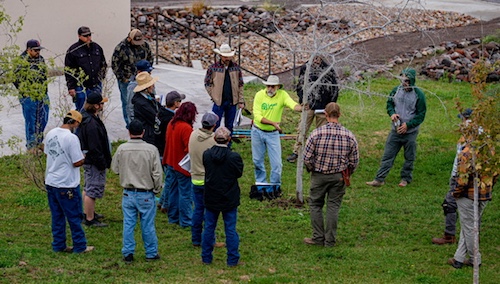
 WNMU students, local forestry experts, municipal representatives and community organizations learning about the causes of tress failure in urban areasSILVER CITY, NM — Western New Mexico University students recently joined forces with local forestry experts, municipal representatives and community organizations on the WNMU Campus for a hands-on educational exercise on the WNMU designed to expose the hidden causes of urban tree failure.
The public event, organized as a shared learning experience, took place at the WNMU Harlan Fleming Commons Garden. Participants carefully excavated a dying tree to investigate root structures, looked for mechanical or environmental stressors, and diagnosed the precise reasons behind its decline.
The cooperative session brought together Principal Ecologist Sarah Hurteau of Integrated Biological Solutions and certified Master Arborist Joran Viers of Legacy Tree Company (International Society of Arboriculture), working alongside WNMU Horticulture Manager Chala Werber. WNMU gardeners, horticulture student workers, the horticulture team, Arboriculture Certificate program students, and partners from the New Mexico Tree Alliance, Greenacción in Parks, and representatives from several local municipalities joined them.
Urban trees in southwestern communities face continuous environmental hurdles. According to regional forestry data, abiotic stress—such as soil compaction, root restriction and improper watering—accounts for most community tree health issues, far outweighing insects or diseases. By digging up a failed tree, participants can examine the root flare and root zones directly, granting a rare look at belowground conditions normally hidden from view.
The session emphasized core diagnostic techniques taught through field-based urban forestry programs. Participants reviewed how trees transport water and nutrients through the vascular systems, how root flares should sit relative to the soil surface, and how common urban hazards—such as leftover twine, girdling roots or mechanical damage from mowers—can choke a tree over time.
"When we look below the surface, we can often find the source of structural issues like girdling roots or planting errors that are indicated by a struggling canopy," said Hurteau. "This autopsy gives our students and municipal partners a firsthand look at how normally invisible underground stressors can shorten the lifespan of an urban tree, helping them recognize the importance of using best practices for tree care."
Werber added, "This investigation allowed participants to read the physical history written in the tree's root zones. By turning a tree failure into an outdoor classroom, we helped equip municipal staff, students, our WNMU gardeners and local volunteers with practical diagnostic skills they'll be able to apply here on campus and back home in their own municipal landscaping and community forestry projects."
Serving as the kickoff to a two-year accelerator program designed to build the skills and knowledge of municipal staff managing landscapes and trees, this event will feature quarterly in-person trainings over the remainder of the grant.
The educational event aligns with broader regional initiatives underway across southwestern New Mexico through a partnership with the Southwest New Mexico Community Forestry Network.
Funded by the USDA Forest Service Urban and Community Forestry Program and the Inflation Reduction Act, the network aims to increase tree equity and support local forestry management plans across rural communities, including Bayard, Deming, Hurley, Lordsburg, Santa Clara, and Silver City.