







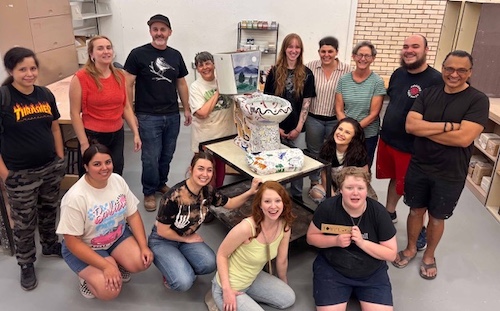
 Participants at a CLAY Festival event hosted by WNMU learn from headlining artistsSILVER CITY, NM — The annual CLAY Festival returned last month with expanded programming for local families, art students and visitors alike, while renewing its founding legacy. Initiated in 2011, the event has operated under the organizational umbrella of Western New Mexico University for several years.
According to Elizabeth ("Lizzie") Slegeir, the WNMU program manager managing the festival, the primary focus for this year was on convergence while celebrating divergence.
"This is a major new chapter of growth for us," Slegeir said. "While the transition and the pandemic required a period of rebuilding, we have officially found our stride. We are firmly rooted, moving forward, and inviting new collaborators to shape what comes next."
A main driver of this year's growth was the expansion of family-oriented events, a direct response to community feedback. Slegeir noted that past iterations featured popular interactive segments, such as the Clay Rodeo, which introduced children to pottery wheels. Building on that idea, the festival launched new hands-on youth programming, including a well-attended event at the Bayard Public Library and specialized activities at the WNMU Museum.
"We love our art scene in Silver City, but sometimes it can be hard to find hands-on activities, especially for younger kids, to really engage," Slegeir remarked. "It definitely fills a community need."
The university itself serves as a vital anchor for the festival's prestigious academic and professional offerings. This year's international juried exhibition at Light Art Space, titled Convergence, features work from artists worldwide. The collection was curated by headlining artists Bradley Klem, Penelope Van Grinsven, and Stephanie Seguin, who also showcased their own work in a concurrent exhibition, Divergence, in the Flash Gallery at Light Art Space.
Community integration extended beyond the campus boundaries. In addition to a lecture on regional historical fermentation vessels at a local brewery, the festival featured a studio tour and talk by Kate Brown, a beloved local potter celebrating 60 years of craftsmanship in Grant County.
The festival also highlighted regional multicultural history through the permanent unveiling of a collaborative tile mural titled Where the Mountains Remember. Designed by artist Delia deVer, the mural was installed on the side of the Century 21 building just off Bullard Street. In tandem with the Youth Mural Project, the dedication ceremony featured traditional Chiricahua Apache music and dancing, turning the unveiling into a true cultural celebration.
Logistically, the festival shifted its traditional July dates to June to better align with the university's fiscal calendar. Although formal attendance was created as a new baseline last year, Slegeir confirmed that direct headcounts at individual events seems to have increased. The festival's popular market alone drew more than 600 attendees, with visitors waiting at the doors ahead of opening time.
Ultimately, Slegeir sees the CLAY Festival integrates the region's rich geological history, indigenous traditions and contemporary ceramic arts.
"Clay people are open; they share, they talk about their processes, and they rely on each other," Slegeir said. "There is chemistry involved, sourcing materials…. we need each other for information and resources. I think it's a wonderful event for our community."
The CLAY Festival welcomes sponsors and other collaborators for its 2027 event.
For more information about WNMU community involvement, programs, courses, and degrees, visit wnmu.edu.