








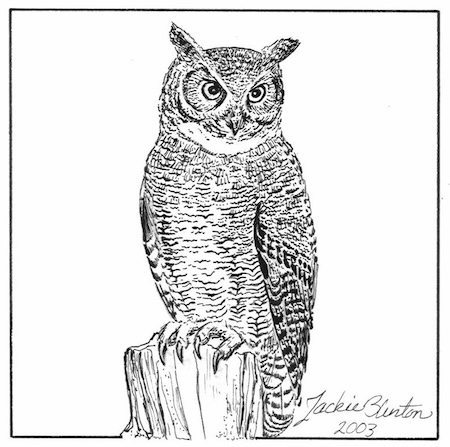
 Art by Jackie Blurton
Nature Note by the late Dr. Roland Shook
Owls range in size from the large Great Horned Owl to the diminutive Elf Owl. These nocturnal birds feed on prey that is somewhat proportional to their size. The Great Horned Owl is as large and powerful as the bigger hawks, and in general feeds on medium-sized prey such as rabbits, rats, squirrels, skunks, and some birds.
Also, to a limited extent, it captures crayfish, frogs, and large insects. All owls have adaptations that allow them to capture prey successfully. These adaptations include modified feathers for silent flight, keen eyesight adapted for night vision, well-developed hearing, and powerful feet equipped with long, sharp talons.
The Great Horned Owl is our most widespread owl that occurs in many wooded habitats. It hunts from a prominent perch and is often visible at dawn and dusk perched on a fence post or telephone pole. Although primarily nocturnal, this species can also hunt by day. It can sail on fixed wings and sometimes soars like a Red-tailed Hawk.
Great Horned Owls are large, dark brown, have a heavily barred body, ear tufts, and yellow eyes. The female is larger than the male. Great Horned Owls often nest in deserted hawk or crow nests, usually in heavy timber.
"The song is a deep hooting in a rhythmic series 'hoohoodoo hoooo hoo,' only slightly deeper than a Mourning Dove" — Sibley.