








Faith Brings No Surprises
We moderns like to imagine faith would be easier if God would simply prove Himself — a sign here, a wonder there, something undeniable. But Scripture tells a different story. Proof never made anyone faithful. It only made them momentarily impressed.
Israel watched the Red Sea split and forgot it within days. The disciples saw storms stilled and panicked at the next wave. Crowds watched Lazarus walk out of the tomb and still demanded Jesus' death. We forget quickly. We backslide easily. We are, as Jesus said, "of little faith."
This is why Jesus so often told people not to broadcast His miracles. He wasn't building a spectacle. He wasn't trying to win with wondrous works. He was calling people into trust — and trust cannot be forced by proof. Proof can silence doubt for a moment, but it cannot bind a heart. Only faith can do that. And faith, by its nature, requires someone already standing where we cannot stand.
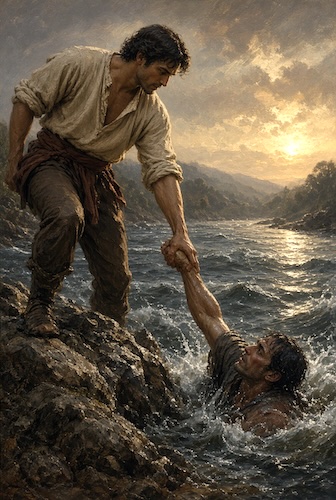
C.S. Lewis once used the image of a drowning man. If you're being swept away by a river, you don't want another drowning man to jump in with you. You want someone with one foot on the bank — someone anchored, someone stronger, someone who can actually pull you out. That "advantage" is not unfair. It is the very reason they can help.
And yet, strangely, some people reject Christ's suffering because He was God. "It must have been easy for Him," they say. As though the Rescuer's strength invalidates the rescue. As though the one with a foot on the bank should be disqualified for not drowning with us.
But the truth is sharper: His suffering and obedience were not just easier because He was God; they were only possible because He was God.
A child cannot teach another child to write. A drowning man cannot save another drowning man. A sinner cannot redeem another sinner.
Only the one who stands where we cannot stand can lift us where we cannot go. This is the mystery of the Incarnation — Jesus fully man and fully God. As man, He could enter our weakness. As God, He could bear its weight. As man, He could suffer. As God, He could make that suffering infinite in value. If He were only man, He could sympathize but not save. If He were only God, He could save but not suffer. Only the God-Man can do both.
And here is the quiet miracle: God still works this way. Not always in thunderclaps, but in the steady hand that keeps hauling us out of the raging waters. We of little faith often fail to recognize it. We demand proof, and proof passes through our fingers like water. Faith alone lets us see.
God is no fool. We are. And yet He keeps pulling us toward the bank, asking only that we wear the life jacket of faith.
It matters not whether the sun rises in the east or the earth simply turns toward the sun. The astronomer can explain the rotation; the farmer can watch the horizon; the child can feel the warmth. But faith brings no surprises in the morning. It is not waiting for the sun to perform. It is waiting for the heart to awaken. The cynic wakes asking whether God will show up today. The believer wakes knowing He already has.
Mechanism changes nothing. Meaning changes everything. Whether dawn comes by cosmic rotation or divine choreography, the light arrives just the same. And faith receives it without astonishment — not because faith is dull, but because faith is anchored in the God-Man who never shifts, never sleeps, never turns away. It expects God to be God.
This is the quiet maturity Scripture keeps pointing toward. Israel forgot the Red Sea. The disciples forgot the loaves. We forget yesterday's mercies as though they were dreams. But faith remembers. Faith is not startled by goodness. Faith is not caught off guard by hope. Faith is not surprised by the steady hand of God. The world may turn. Circumstances may shift. The sun may rise, or the earth may rotate. But the believer's footing does not change.
Faith is the orientation of a soul that has stopped bargaining with God. It is the posture of someone who no longer divides life into "on parade" and "off parade," no longer paying the tax of obedience and hoping there's enough left over for themselves. Faith is the life of the one who can say with Paul, "To live is Christ," and mean it.
And when a person reaches that place — or even begins to hunger for it — the mornings become steady. Not predictable in circumstance, but predictable in Presence. The light may fall differently each day, but the One behind the light does not change.
So it matters not whether the sun rises or the earth turns. Faith brings no surprises in the morning. Because faith has learned to trust the One who never sleeps, never shifts, never turns away. And that is enough.
Amen